
Home Operations
What Becomes Possible When a Home Can Remember?
Thirty seconds of thinking about an architect's vision led me to a much bigger question. What happens when we invite everyone else to imagine the possibilities?
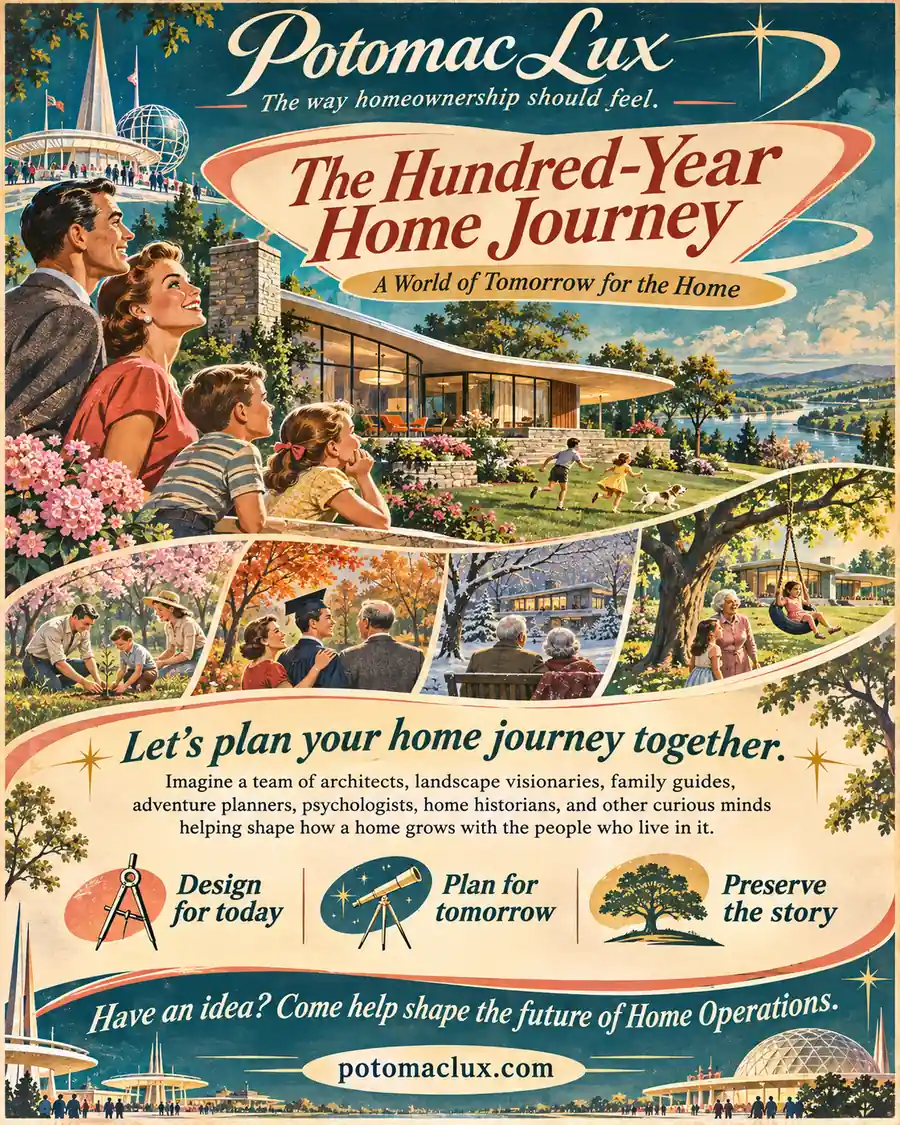
I’ve spent a lot of time thinking about what happens to a home after it’s built. The contractors who work on it, the repairs that get forgotten, the warranties that disappear, and the systems nobody really understands until something breaks. That’s a big part of why we’re building Potomac Lux. I’ve been thinking about the health of the house, how we preserve its history, and how we make all that information useful to the people who actually live there. But the other day, while thinking through some of these ideas, my mind wandered somewhere I hadn’t really considered before.
I started wondering what would happen if an architect could leave a little more information behind. Not just the blueprints or specifications, but the actual thinking behind the design. Why did they choose that particular stone? Why did they position a window in that direction? Why did they want vines climbing one side of the house? What if they could explain those decisions to the families who would eventually live there, even decades after the home was built? And what if that information could remain part of the home’s history instead of disappearing when the project was finished?
What if an architect designed a journey?
Imagine buying a home and discovering a message from the architect who designed it 30 years earlier. Something like, “We planted this oak tree knowing it would eventually shade the living room in the afternoon. When the house was first built, the room received direct sunlight. As the tree matured, we imagined the light becoming softer and the space more peaceful.” Suddenly, that tree isn’t just a tree. It’s part of a much larger vision that someone had for the property, and now you’re experiencing something that was imagined decades before you ever arrived.
That got me thinking about what architecture could become if we started looking at homes as journeys instead of finished products. An architect could still do exactly what architects do today, but what if a firm could also offer a long-term experience surrounding the home? What if entirely new teams were created to help families understand how their properties were meant to evolve? You could have an architect thinking about the original design, a landscape specialist imagining how the surroundings will mature, and someone focused on how the home might adapt as a family grows older. Suddenly, we’re talking about potential new services, new careers, and even entirely new businesses built around the life of a home rather than just its construction.
And here’s the funny part. That entire train of thought took about 30 seconds. Seriously. I was just thinking about what would happen if an architect could add a little information to a home’s history, and within half a minute, I was imagining entirely new ways for people to work, collaborate, and create value around homeownership.
Now imagine what an actual expert could come up with
Here’s where things get interesting, because I’m not an architect. I’m not a structural engineer, and I certainly don’t design those incredible sustainable Earthship homes out in the desert. I’m just a regular guy trying to figure out a better way for people to understand and care for their homes. I don’t have the training or experience that these people have, and I wouldn’t pretend otherwise. But if someone like me can come up with these possibilities after 30 seconds of thinking about architecture, imagine what could happen if I sat down with someone who actually understands the profession.
What if I asked an architect how they would use a platform that could preserve their design intentions for future generations? What if I asked an engineer what information they wish every homeowner could access? What if I asked someone who designs sustainable homes what possibilities they see when a property can preserve decades of knowledge about how it performs and interacts with its surroundings? I genuinely have no idea what their answers would be, and that’s what makes this so interesting to me. They might come up with something ten times more useful than anything I’ve imagined. They might tell me that I’m thinking about the entire thing backward. Either way, I want to hear it.
We’ve been thinking about the health of the house. Now let’s imagine its entire life.
Up until now, much of our thinking at Potomac Lux has focused on preserving the practical history of a home. When was the roof replaced? Why was an electrical circuit rerouted? What did the plumber discover behind a wall? Those are important questions because that knowledge can save homeowners time, money, and unnecessary frustration. But there’s no reason we have to stop there. Once we have a foundation that allows a home to retain meaningful information over time, we can begin exploring possibilities that extend far beyond maintenance and repairs.
A home has an entire life. It begins as an idea, becomes a physical structure, changes with the people who live inside it, and eventually passes into the hands of another family. Along the way, countless people contribute knowledge, make decisions, and leave their mark on the property. Some of that information is technical, some is personal, and some might not seem particularly important until 50 years later. What interests me is the possibility of preserving the knowledge that matters and making it available when someone actually needs it, with homeowners controlling what they choose to keep and share.
That’s when this stops being a conversation about another home maintenance app. We’re talking about Home Operations, an entirely different approach to the relationship between people and their homes. We’re building the foundation for that today, and there is still plenty of work to do. I’m not claiming we’ve already built every capability I’m describing here. Far from it. But I think the opportunity becomes a lot more exciting when we stop asking what features we should add and start asking what people might be able to accomplish.
I don’t want to have all the answers
One thing I want to make absolutely clear is that I’m not trying to tell architects how to practice architecture or engineers how to do engineering. If anything, the whole point is that I know how much I don’t know. I’ve been able to put together a vision for Potomac Lux, build a substantial part of the foundation, and explore how the experience should work for homeowners. But once someone understands what we’re trying to accomplish, I want them to challenge it. If there’s a better way to approach something, a possibility we’ve overlooked, or an entirely different direction worth considering, I’m all ears.
And that’s why I think the next chapter of this project needs to involve a lot more people. Imagine bringing together individuals who have spent their entire careers solving problems in fields I barely understand. Give them the basic premise that a home can preserve its history, knowledge, and intentions over time, and ask them what they would do with that capability. Some might see opportunities to improve existing services. Others might imagine entirely new professions or businesses. And I’m willing to bet that some of the best ideas will come from people whose work seems to have absolutely nothing to do with homeownership.
This is an invitation to everyone
We’re building Potomac Lux right now. The foundation is taking shape, and we’re working toward getting more homeowners actively using it. There are still technical challenges to solve, assumptions to test, and a great deal to learn. But the vision is real, and I don’t see any reason to wait until we have every answer before inviting other people into the conversation. In fact, I think waiting would be a mistake, because the whole purpose of asking for help is to discover the things we haven’t thought of yet.
And please don’t misunderstand what I’m asking. You don’t have to be an architect, an engineer, or somebody with an impressive title. Maybe you’re an IT guy who understands something about technology that I’ve completely overlooked. Maybe you’ve spent decades working on houses and know exactly where the industry gets things wrong. Or maybe you raise ducks for a living and, for reasons I couldn’t possibly imagine, you’ve got an idea that could change how we think about all of this. Who knows? That’s the point. Good ideas don’t always come from the people you’d expect, and I’m not interested in excluding somebody simply because their résumé doesn’t look like it belongs in the conversation.
Think about where this whole discussion started. I spent roughly 30 seconds wondering what an architect might want to tell the future owners of a home, and it led to an entirely new way of thinking about design, the passage of time, and potential businesses surrounding the homeownership experience. Now imagine what happens when hundreds or thousands of people start contributing their own perspectives. We might discover solutions to problems we’ve been struggling with for years. We might uncover opportunities nobody realized existed. We might even create something that looks completely different from what any of us initially imagined.
So here’s my invitation. If you’ve got an idea, I want to hear it. If you think we’re missing something, tell me. If you’d like to help shape what we’re building, reach out. It doesn’t matter whether you’re a homeowner, a business owner, a student, or somebody who just happened to read this and thought of something interesting. You don’t need permission, credentials, or a perfectly polished proposal to join the conversation. And if your idea has nothing to do with the examples I’ve mentioned, that’s even better. I want to hear the things I haven’t considered.
We’re building Potomac Lux because I believe there’s a much better way for people to experience homeownership. I don’t know exactly where every possibility will lead, and I don’t pretend to have all the answers. What I do know is that I’d much rather explore those possibilities with people who see the world differently than try to figure everything out on my own.
This is happening, folks. If you’ve got something to contribute, come be part of it.
The way homeownership should feel.
Potomac Lux
Have an idea? Share it with us.
After reading this article,
ask yourself one question:
If something important happened in your home tomorrow, would you know exactly where to find the history?
Start building your home’s memory today.
START YOUR HOME RECORD →Free to use. Paid projects and hands-on services are priced separately.
Continue Exploring
If this interested you, explore these next.
Three carefully selected stories that develop the ideas in this article, without sending you off on an unrelated tangent.
Home Memory
The Day Homes Started Remembering
A cornerstone essay on home memory, home history, and the quiet transformation that begins when a home's records, decisions, and lessons remain connected over time.
Home Memory
What If Your Best Referral Came From the House Itself?
A Potomac Lux Journal essay on contractor legacy, home memory, and how exceptional work can keep earning trust long after a project is complete.
Home stewardship
The Lost Art of Stewardship
A reflection on why modern homeownership needs more than alerts, dashboards, and maintenance reminders. It needs stewardship, continuity, context, and calm human judgment.