
Home Memory
The Day Homes Started Remembering
A cornerstone essay on home memory, home history, and the quiet transformation that begins when a home's records, decisions, and lessons remain connected over time.

Early one spring morning in a quiet suburb outside Washington, D.C., on a day like any other, something happened that may one day be remembered as a turning point in the history of homeownership.
A house remembered.
Not consciously. Not emotionally. Not because it became alive.
But for the first time, the story of the home could remain connected to the home itself.
A repair would no longer disappear because a homeowner moved away. A lesson would no longer vanish because a contractor retired. A decision would no longer be forgotten because a folder was misplaced. The home could retain its own history.
At first glance, this may seem insignificant.
It is anything but.
The retention of memory is one of the things that separates us from other animals. Human civilization exists because knowledge survives. Every generation inherits lessons from those who came before it. Every profession builds upon discoveries made by earlier generations. Every advancement becomes the foundation for the next.
Knowledge compounds.
For thousands of years, humanity fought a single battle: how do we stop losing what we learn?

We painted on cave walls. We wrote on parchment. We built libraries. We created universities. We invented databases and eventually connected much of the world’s knowledge through the internet. The technologies changed. The objective never did.
Preserve understanding.
Pass it forward.
Do not start from zero.
In many ways, civilization itself is simply memory compounded over time. Every doctor inherits discoveries made by previous doctors. Every engineer benefits from lessons learned by previous engineers. Every scientist begins further ahead because someone took the time to preserve what they learned.
The modern world exists because memory became persistent.
And yet, somehow, homes were left behind.
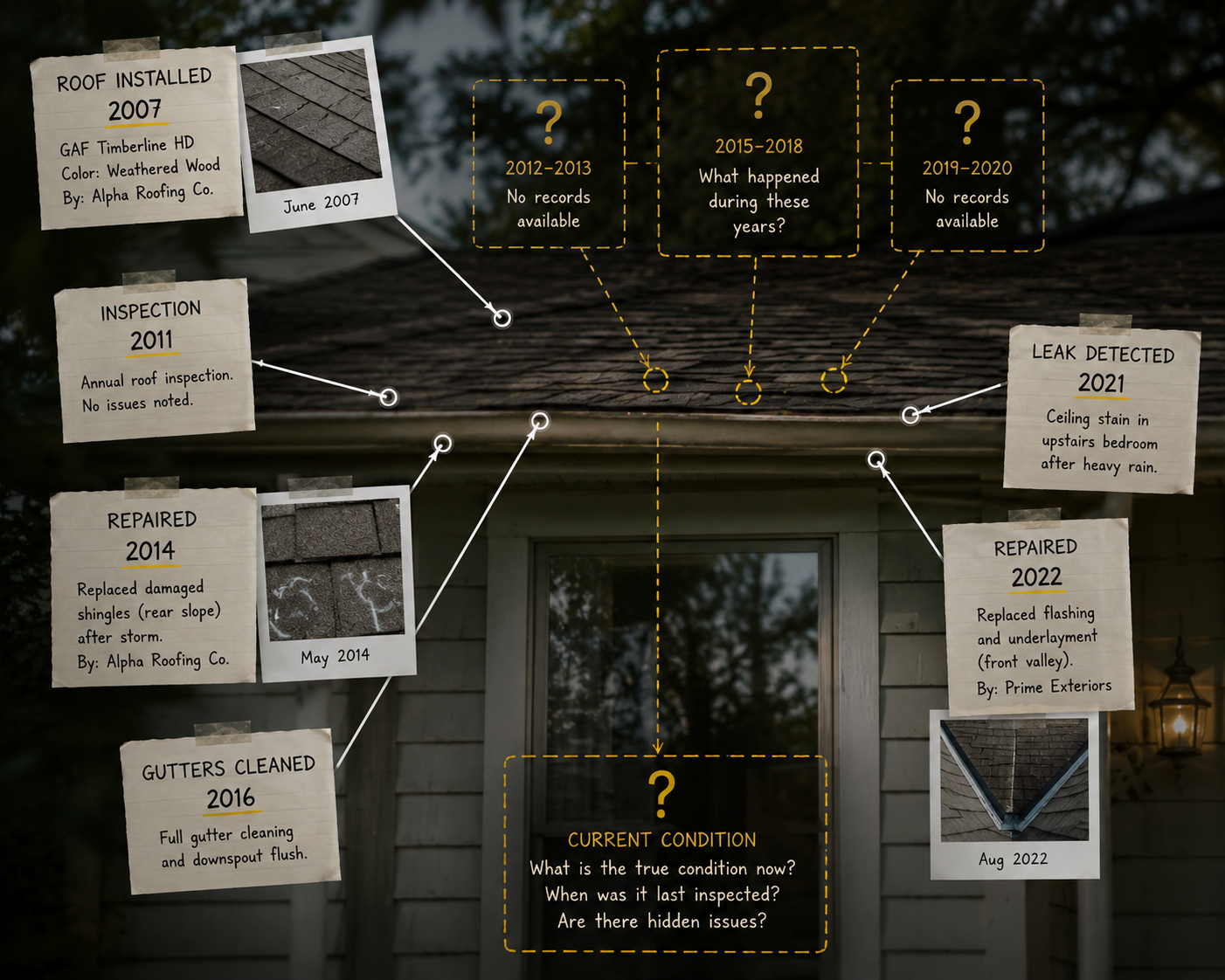
For most of history, people understood their homes intimately. Many built them. Many repaired them. Many passed knowledge directly to their children and grandchildren. The home and its history remained connected.
Then something changed.
Homes became more sophisticated. Their systems multiplied. Their materials evolved. Their complexity increased dramatically. The average home today contains layers of infrastructure, technology, and specialized equipment that would have been unimaginable just a few generations ago.
At the same time, fewer homeowners were expected to understand those systems themselves.
So we turned to specialists.
And we should have.
There is nothing wrong with expertise. Modern homeownership depends on it.
The problem is that expertise was never meant to operate in a vacuum.
Imagine visiting a doctor with no medical history. Imagine hiring an attorney with no records. Imagine trying to run a company where every employee forgets everything every five years.
The challenge is not expertise.
The challenge is missing context.
Yet that is precisely how many homes operate.
A water heater is replaced. A repair is performed. A recommendation is made. A warranty is issued. A lesson is learned.
Then the information disappears.
A homeowner moves. A contractor retires. An email account changes. A folder gets lost.
The home keeps teaching lessons.
The lessons keep disappearing.
Over time, we accepted something that would seem absurd in almost any other field. We accepted amnesia as the operating system of homeownership.
Think about that for a moment.
The largest asset most people will ever own. The place where families build their lives. The structure that may survive for a century or more.
And we somehow decided that its history should be scattered across filing cabinets, inboxes, contractor databases, junk drawers, and fading memories.
We solved memory for science.
We solved memory for business.
We solved memory for medicine.
We solved memory for nearly every aspect of modern life.
But when it came to homes, we continued asking each new owner to start over.
The result is familiar.
A problem appears.
A contractor arrives.
A recommendation is made.
A price is quoted.
And the homeowner is expected to make an important decision while seeing only part of the picture.
Not because anyone is dishonest.
Not because anyone is incompetent.
Because the context no longer exists.
The homeowner does not know what happened before.
The contractor does not know what happened before.
The home knows.
But the home cannot tell anyone.
At least, it couldn’t.
Because what happens when a home remembers?
That is where the story becomes interesting.
When a home’s history survives, something subtle begins to change.
The homeowner no longer has to carry the entire burden of remembering.
Past repairs remain accessible. Previous decisions retain their context. Patterns become visible. The difference between a recurring issue and an isolated event becomes easier to understand.
The home begins contributing to the conversation.
Not with opinions.
Not with diagnoses.
With context.
And context changes everything.
The homeowner no longer arrives at a decision empty-handed. The contractor no longer begins every investigation from scratch. Instead of reconstructing the past from fragments, everyone starts from a shared understanding of what has already happened.
The homeowner brings context.
The specialist brings expertise.
The home brings history.
That is a much better place to begin.
Perhaps the greatest benefit is not that homes become more intelligent.
It is that homeowners become more confident.
The goal is not to replace contractors, inspectors, or specialists. The goal is not to transform homeowners into experts. The goal is not to eliminate professional judgment.
The goal is to create better conversations and better decisions.
When history survives, trust becomes easier. Recommendations become easier to evaluate. Projects become easier to manage. Homeowners spend less time searching for information and more time using it.
The home becomes easier to maintain.
Easier to improve.
Easier to understand.
Easier to trust.
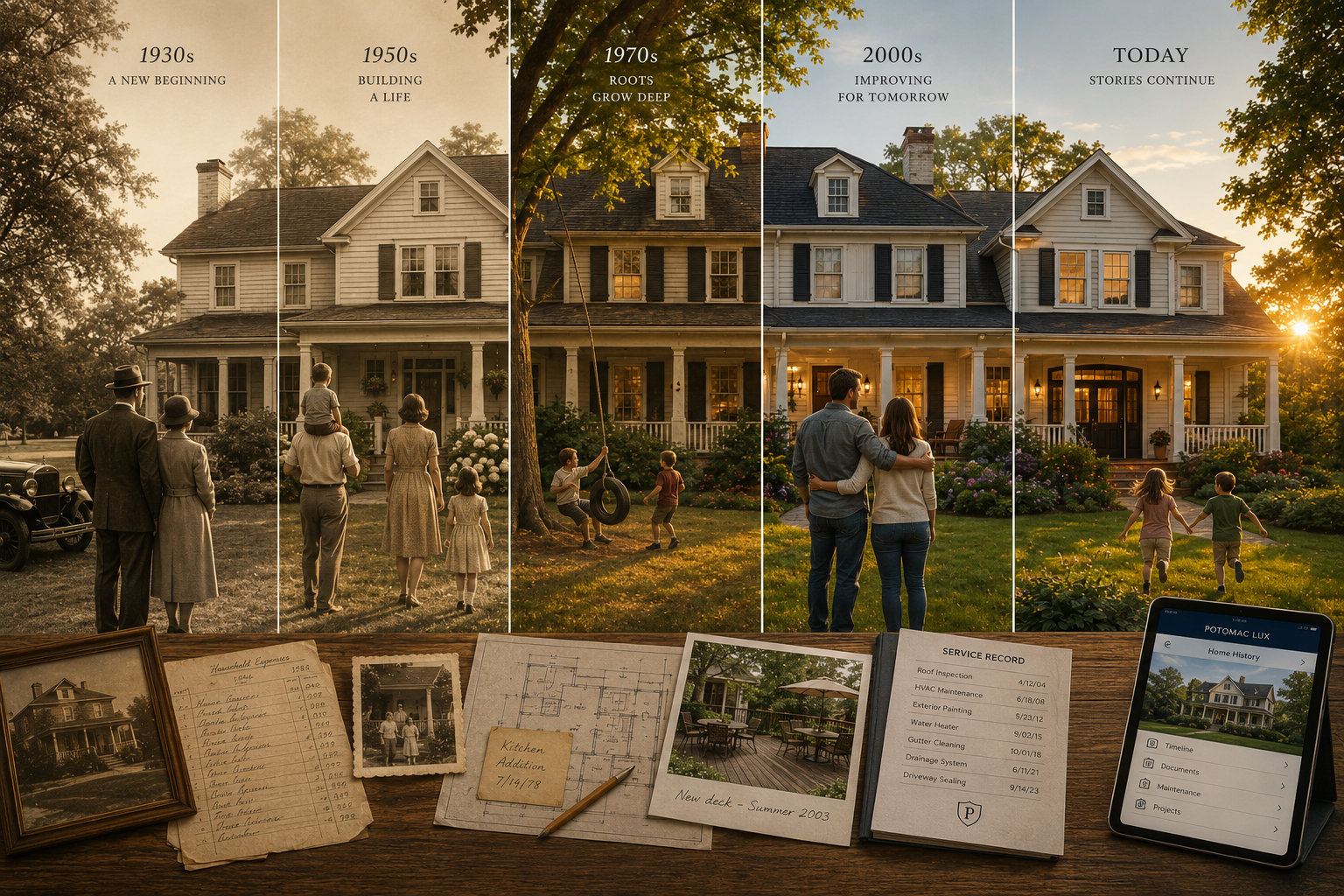
Over time, every repair, every project, and every observation contributes to something larger than itself.
Continuity.
Knowledge begins accumulating instead of disappearing.
And once knowledge starts accumulating, the home becomes more valuable in a way that has nothing to do with square footage, finishes, or market conditions.
It becomes understood.
For centuries, every major leap in civilization followed the same pattern. Knowledge became easier to preserve. Knowledge became easier to share. People stopped having to start from zero.
Perhaps the next chapter is smaller.
Perhaps it begins at home.
Not with smarter devices.
Not with more alerts.
Not with another dashboard.
But with memory.
Because a home should not have to start from zero every time ownership changes. A homeowner should not have to start from zero every time a project begins. And a specialist should not have to start from zero every time they walk through the door.
One day, the moment homes started remembering may feel less important than it does today.
Or it may feel as important as the day we started using written language.
After reading this article,
ask yourself one question:
If something important happened in your home tomorrow, would you know exactly where to find the history?
Start building your home’s memory today.
Start Your Home Memory →Free to start. No downloads needed. No pressure. No pushy sales. Ever.