
Calm homeownership
I Meant to Take Care of That
Home maintenance shouldn’t depend on memory. See how a recurring schedule reduces the mental load of owning a home and helps your house run smoothly.
Why owning a home shouldn’t require remembering everything yourself.
A few weeks ago, I stepped out of my car and really looked at my yard for the first time in a while.
It was bad.
Not “the county is about to condemn the property” bad. But everything had grown just enough that I suddenly realized the landscaper upgraded from quick 30 minute maintenance to a whole project that was gonna take. It’s good long time.
I had meant to take care of it. Then I sprained my ankle and spent a good chunk of the next three weeks barely getting around. Meanwhile, it was summer, which apparently means every plant on your property gets together at night and agrees to grow six inches before morning.
There was a tree with a bunch of dead branches that I had already noticed once before. I had been meaning to get somebody out to trim it. Then everything started growing, and I started thinking maybe I wasn’t supposed to cut certain things yet because some bushes should be trimmed after they go dormant in the fall. Or maybe before. Or after they flower. Or maybe there is some very specific Tuesday in October when shrubs are emotionally prepared for this.
I wasn’t quite sure.
All I knew was that I had blinked and several weeks had passed.
And then another mystery was solved.
Our delivery guy had been leaving packages by a different door. I thought he had just realized that we use the kitchen door more than the front door.
But nope.
Our front pathway had overgrown like I was getting ready to film a Jurassic Park movie.
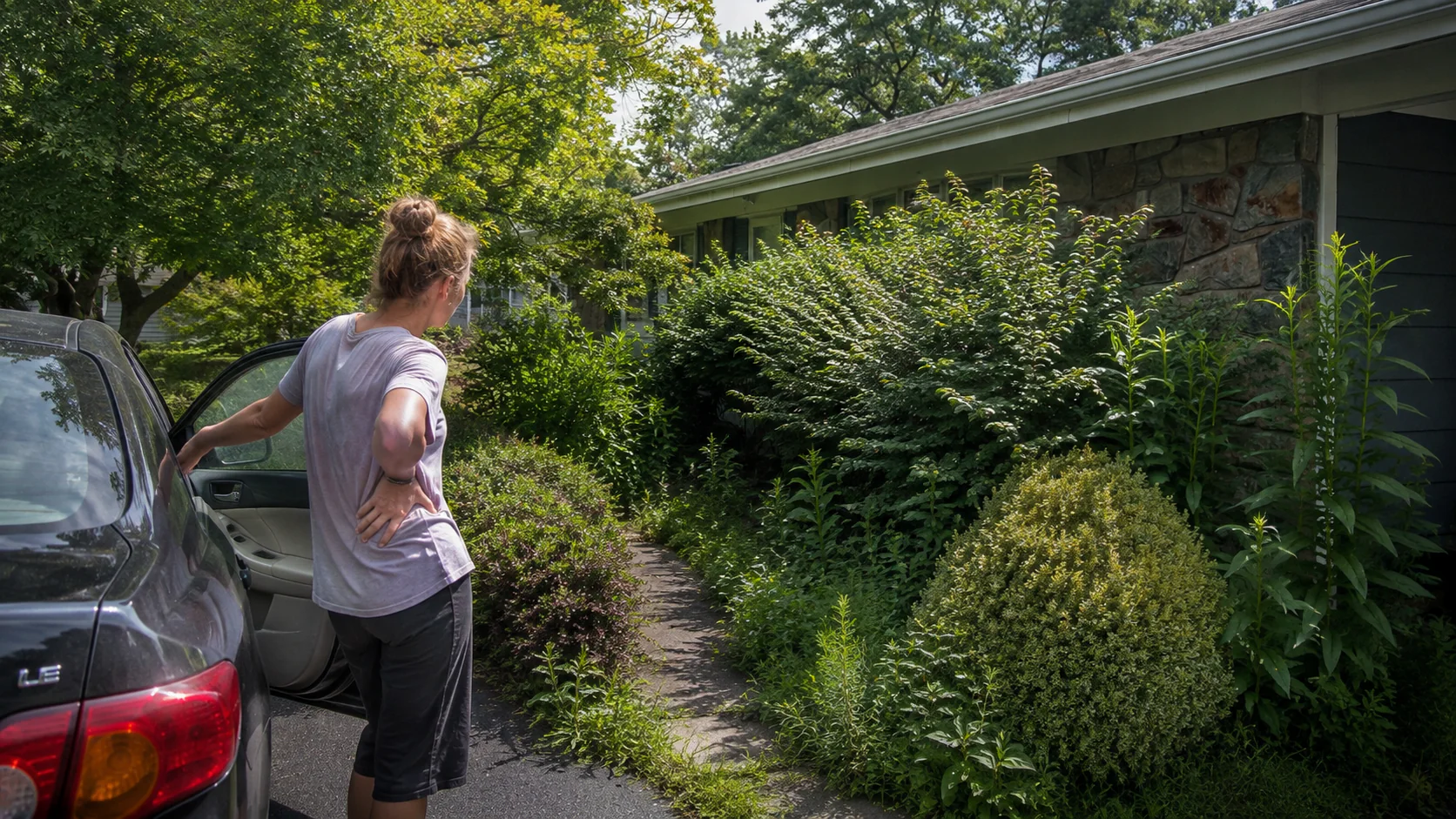
Apparently the delivery guy had conducted a property assessment before I did and quietly rerouted himself.
That is homeownership.
I Meant to Take Care of That
There may not be a sentence homeowners say more often than this one:
I meant to take care of that.
I meant to clean the gutters. I meant to call somebody about that tree. I meant to have the HVAC serviced. I meant to check the dryer vent. I meant to figure out why that one section of the fence is leaning slightly farther every year. I meant to change that filter. I meant to call the plumber.
And you really did mean to.
Then Tuesday happened.
Then one of the kids needed something for school. Work got busy. Somebody got sick. You went away for a weekend. The dishwasher started making a sound it wasn’t making before. You needed tires. Somebody had a birthday. You had to fill out a form you didn’t know existed.
Then you blink.
Six months are gone.
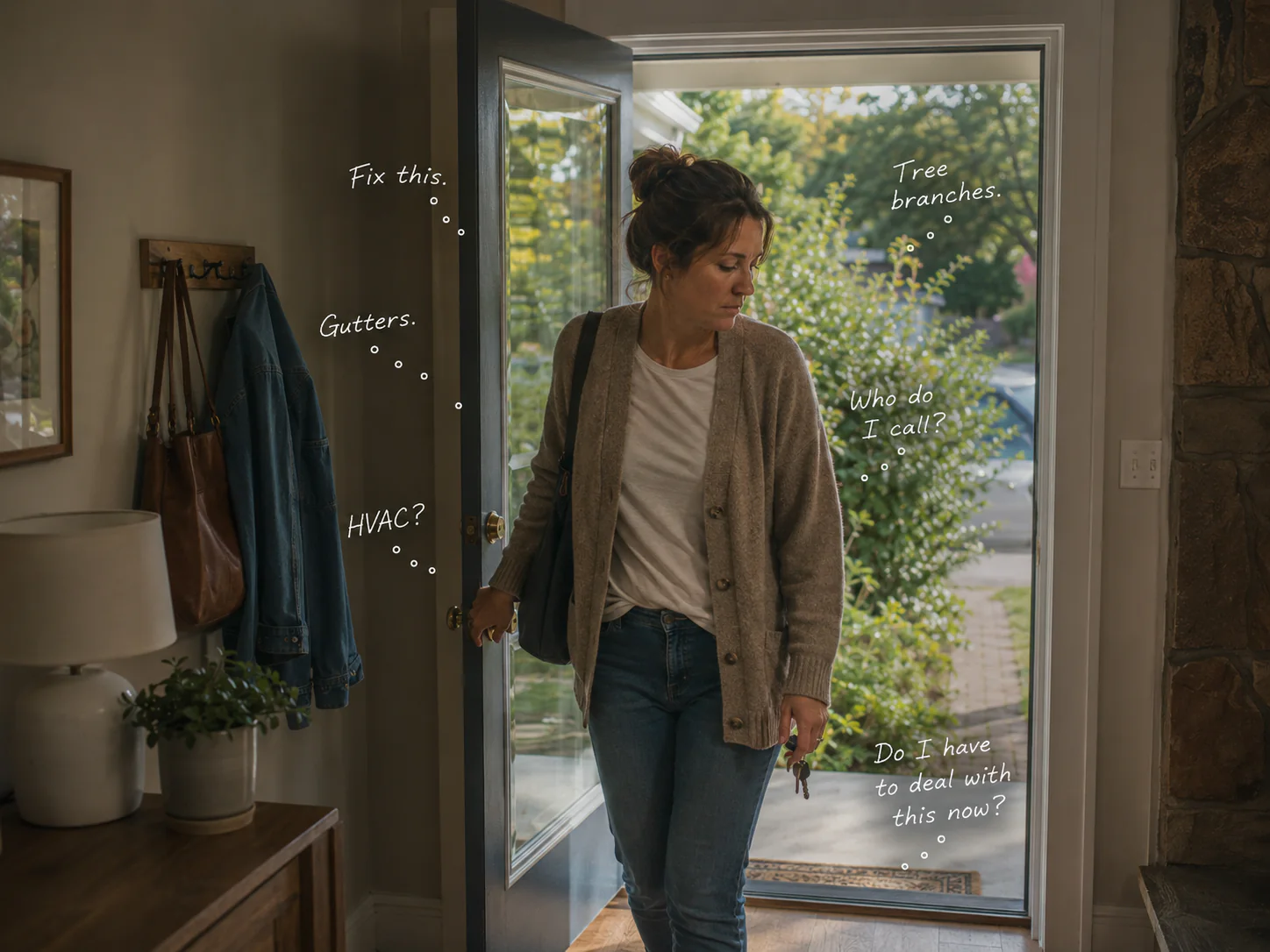
Summer started five minutes ago and somehow the kids are already going back to school.
That’s how time works once you own a house. The calendar continues moving normally. Your house, meanwhile, is quietly keeping its own schedule and apparently expects you to know what it is.
Your House Has a Schedule Whether You Do or Not
The funny thing is that houses are actually pretty predictable.
HVAC systems need service. Gutters need cleaning. Trees need attention. Pest treatments happen on a schedule. Dryer vents need cleaning. Filters need replacing. Irrigation systems need winterizing. Exterior surfaces need checking. Appliances need maintenance. Chimneys, roofs, sump pumps, water heaters and dozens of other things all have their own rhythms. A useful home maintenance schedule brings those rhythms into one plan.
The house already has a maintenance calendar.
Most homeowners just don’t have access to it in any useful way.
Instead, the calendar lives partly in your head, partly in an email from a contractor two years ago, partly on a sticker somebody put on the furnace, partly in a manual you definitely still own somewhere, and partly in those random moments when you happen to walk past something and think, “Was that always doing that?”
That isn’t really a system.
That’s remembering things by accident.
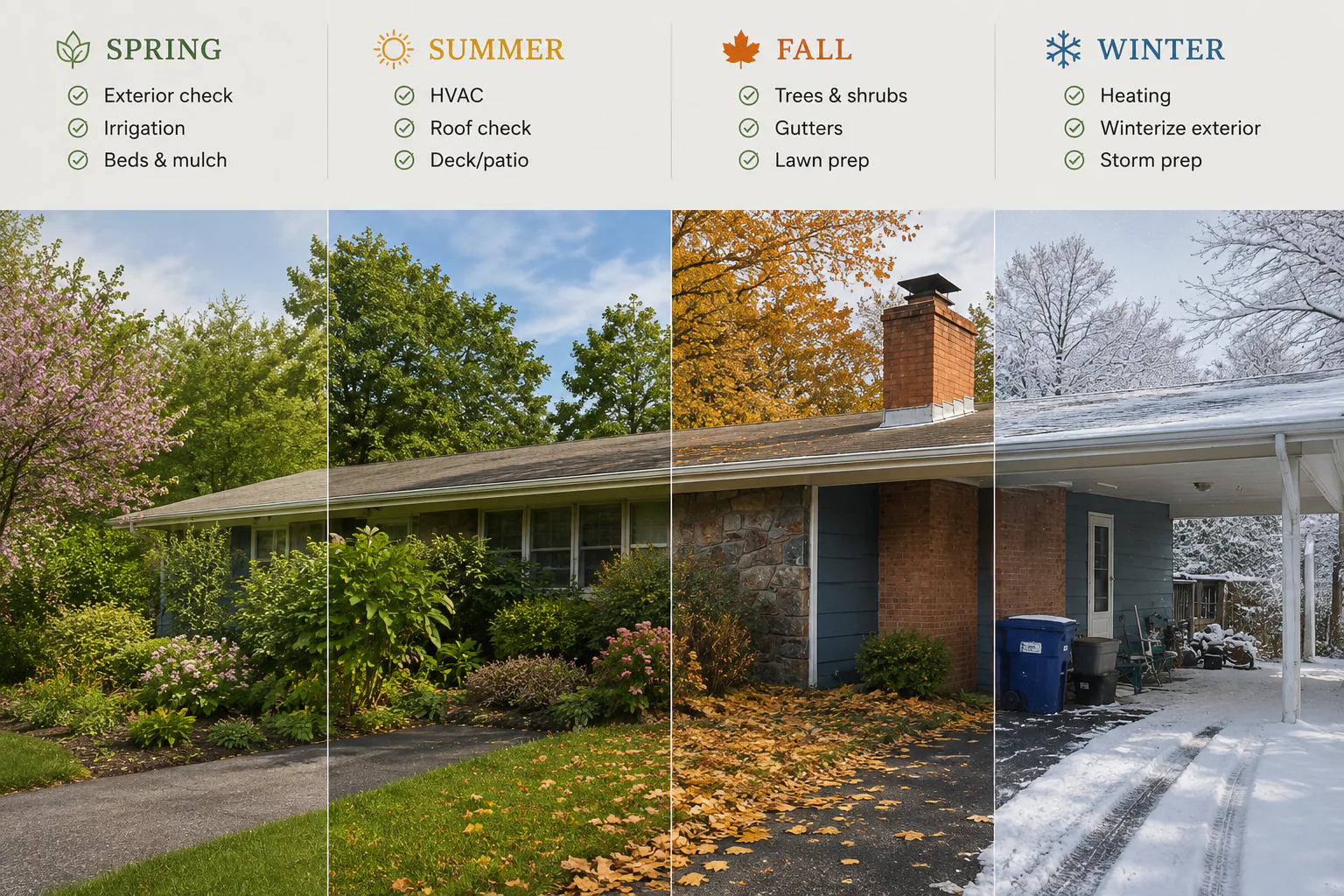
And it works surprisingly well right up until it doesn’t.
The Pest-Control People Figured This Out Years Ago
I have a pest-control company.
They come every few months. During mosquito season, they do additional treatments. I don’t wake up one morning and think, “You know what I should research today? The reproductive cycle of mosquitoes.”
They just come.
I don’t search Google again. I don’t get three new estimates. I don’t compare reviews. I don’t try to remember who we used last time. I don’t negotiate a new appointment every three months.
It’s already handled.
When the bill comes, I look at it, the price is fair, and honestly, I don’t really think much more about it.
They’ve taken care of it.
I don’t have bugs. I don’t have mosquitoes eating me alive every time I step outside. The price makes sense. Everybody knows what they’re supposed to do.
That is an incredibly underrated form of luxury.
Not having to think about something.
Maybe Real Luxury Is Having Fewer Things to Think About
There’s an idea I’ve always liked: people with less money often have to spend more of their time solving problems themselves, while people with more resources can spend money to buy some of that time back.
I don’t think that means you should throw money at everything.
I think it means that when you can afford to, one of the smartest things you can buy is your own time.
But even that doesn’t quite explain the whole feeling.
Because the pest-control company isn’t just saving me the time it would take to spray the yard. They are removing the entire problem from my brain.
I don’t have to remember when they’re due.
I don’t have to wonder whether I forgot.
I don’t have to research anything.
I don’t have to make the call.
I don’t have to put it on the calendar.
Somebody competent is taking care of it. The price is fair. The problem is handled.
That combination of time and peace of mind is, to me, the real luxury.
Maybe real luxury isn’t having more things.
Maybe it’s having fewer things you have to think about.
That Is What a Resort Gets Right
Think about the last time you stayed at a well-run resort.
You didn’t arrive and immediately start wondering when somebody last checked the air-conditioning system.
You didn’t inspect the landscaping and make a note to find a tree company.
Nobody handed you a card at check-in saying, “Welcome. Your room is on the fourth floor. Breakfast begins at seven. Also, we’re a little concerned about the water heater, so if you could find a plumber while you’re here, that would be fantastic.”
You assume somebody is taking care of the place.
That’s part of what you’re paying for.
There are people who know what to check. There are schedules. There are systems. Rooms get cleaned. Pools get serviced. Landscaping gets maintained. Equipment gets inspected. Things happen in the background before guests ever have to notice them.
And if something does go wrong?
You call the front desk.
One call.
You don’t sit on the edge of the bed searching “best emergency plumber near me” and then spend 45 minutes trying to determine whether 4.7 stars from 312 strangers constitutes sufficient evidence of plumbing competence.
Somebody else already figured that part out.
That feeling is something I’ve been thinking about a lot as we build Potomac Lux.
Why shouldn’t your home work more like that?
The Real Luxury Is a House That Runs Well
When people hear “luxury home service,” it’s easy to picture extravagant things.
That’s not really what interests me.
I think luxury can be much simpler.
The heat works. The water works. The yard is under control. The house is clean. The tree isn’t dropping a dead limb on somebody’s car. The bugs stay outside. The gutters aren’t overflowing.
And when something needs attention, you don’t have to start an entirely new research project to deal with it.
The house just runs well.
That is the experience.
You go live your life.
Somebody, or better yet, some system, is paying attention to the house.
You Don’t Need an Estate Manager. You Need the System an Estate Manager Would Build.
If you’re extraordinarily wealthy, you can solve this problem the old-fashioned way.
Hire somebody.
Give them a clipboard.
Tell them to take care of the estate.
Most homeowners aren’t doing that, including plenty of people who own very expensive homes.
And increasingly, they shouldn’t have to.
Because most of what an excellent home manager would create is a system.
They would know what equipment is in the house. They would know what was serviced and when. They would know which contractor did the work. They would know when recurring maintenance comes due. They would keep the records. They would have reliable people to call. They would notice patterns. They would coordinate the work.
And they would bring the homeowner in when an actual decision needed to be made.
That’s the important part.
You don’t necessarily need a person standing in your kitchen waiting for your gutter-cleaning anniversary.
You need the system they would have built.
Set It. Then Let the System Remember.
Imagine buying a home and gradually creating a real operating plan for it.
The HVAC service goes on the schedule.
So does the gutter cleaning.
Pest control.
Tree inspections.
Seasonal landscaping.
Dryer-vent cleaning.
Irrigation shutdown.
Whatever your house actually needs.
Not a generic Internet checklist containing 137 things you’re now supposed to worry about.
Your house.
Your equipment.
Your property.
Your history.
Your schedule.
And here’s the part I think matters most: sometimes something comes due and you can’t deal with it yet.
Maybe money is tight.
Maybe something more urgent happened.
Maybe the roof has to come before the landscaping.
Fine.
Postpone it.
But don’t lose it.
It stays on the list.
You still know it needs attention. You know how long it has been waiting. You can come back to it when you’re ready.
That alone is better than relying on yourself to suddenly remember six months later while you’re limping past a bush and holding onto your car so you don’t fall down.
What Does Routine Home Maintenance Actually Cost?
The maintenance itself costs whatever the service costs.
That part doesn’t magically disappear.
If you need an HVAC technician, an arborist, a plumber, a pest-control company, a gutter cleaner or anybody else to actually perform work, somebody has to pay for the work.
But the remembering part?
The organizing part?
The “what needs to happen next?” part?
That’s exactly the part Potomac Lux is being built to help with, and the Potomac Lux home-management platform itself is free for homeowners.
Your house can have a memory without you paying somebody to stand there and have the memory for you.
Some service providers are also perfectly willing to inspect or evaluate something at little or no initial cost because if actual work is needed, they have the opportunity to earn that work. Others may charge a service or diagnostic fee. Either way, the homeowner gets visibility into what needs attention without having to rebuild the entire process from scratch every time.
That’s the distinction.
The work may cost money. The brain doesn’t have to.
And Yes, Sometimes You Can’t Afford to Do Everything
There’s another part of homeownership we shouldn’t pretend doesn’t exist.
Sometimes you know something needs to be done and you simply don’t have the money to do it right now.
I’ve been there.
I’m there with some things right now.
A system doesn’t magically make repairs free.
And I don’t think homeowners need another app telling them they’re failing because they didn’t complete all 43 items on this month’s Ultimate Home Maintenance Checklist.
Sometimes the answer is simply:
Not yet.
That’s okay.
Put it on the list.
Postpone it.
Come back to it.
The point is that it doesn’t disappear.
Because knowing what needs attention, what is urgent, what can wait and what is coming next is substantially better than being surprised by everything.
The goal isn’t perfection.
The goal is control.
Homeownership Shouldn’t Be a Memory Test
Maybe that’s the part we’ve gotten wrong.
We keep treating responsible homeownership as though the homeowner should personally remember everything.
Good homeowners change the filters.
Good homeowners clean the gutters.
Good homeowners inspect the roof.
Good homeowners remember the trees.
Good homeowners know when the water heater was last serviced.
Good homeowners apparently wake up every morning with a complete maintenance history of a complicated physical structure available for immediate recall.
Why?
We don’t operate most important things this way anymore.
Your phone remembers appointments.
Your bank remembers recurring payments.
Your car tells you when it needs service.
Your pharmacy reminds you about prescriptions.
Your pest-control company remembers when it’s time to come back.
But the most expensive thing most people will ever own still largely operates on:
“Didn’t we do that recently?”
Apparently not.
It was 2023.

A Better Way to Live With Your Home
That afternoon, standing next to my overgrown yard with one useful ankle, I knew exactly what I should do.
I should call somebody.
I should figure out the tree.
I should figure out the bushes.
I should probably figure out why the delivery guy has quietly abandoned our front entrance.
And chances are, by the time I made it inside with my little wobble, I was going to forget at least part of it.
Because that’s life.
That’s not a character flaw.
That’s why calmer home systems exist.
The vision behind Potomac Lux is pretty simple: your home should not require you to remember everything it needs.
The house should have a memory.
The maintenance should have a schedule.
The things you can’t afford today should stay on the list for tomorrow.
Reliable professionals should already be part of the equation.
And when something needs attention, getting it handled should feel less like launching a small procurement exercise and more like calling the front desk.
Because the best version of homeownership isn’t spending your weekends becoming an expert in gutters, trees, furnaces and mosquito control.
It’s having the time to live your life and the peace of mind of knowing that somebody is keeping an eye on the house.
And ideally, still being able to get through the front door.
Direct Answer: What Is a Home Maintenance Management System?
A home maintenance management system keeps track of a home’s equipment, service history, recurring maintenance needs, upcoming tasks and trusted service professionals in one organized place. Instead of relying on the homeowner to remember every task, the system helps identify what needs attention, when it is due and who may be able to handle it.
If a task cannot be completed immediately, it can remain on the homeowner’s list and be postponed rather than forgotten.
Potomac Lux is building this home-management layer for homeowners at no cost. Homeowners still pay service professionals for actual work they approve.
Frequently Asked Questions
What home maintenance should be scheduled automatically?
Recurring services are the best candidates. Depending on the property, these may include HVAC maintenance, pest control, gutter cleaning, dryer-vent cleaning, landscaping, tree care, irrigation service, chimney inspections and other seasonal work. The schedule should be based on the actual home and its systems rather than a generic checklist.
What if I cannot afford a maintenance item right now?
Postpone it. The important thing is not to lose track of it. A useful home-management system should keep the item visible so the homeowner can return to it when the timing or budget makes sense.
Does Potomac Lux charge homeowners to keep track of maintenance?
No. Potomac Lux’s home-management platform is free for homeowners. Homeowners pay service providers for actual services or repairs they choose to approve.
Do service providers charge to inspect a problem?
It depends on the provider and the type of work. Some professionals offer complimentary estimates or initial evaluations because they may earn the work if a repair or service is needed. Others charge diagnostic, consultation or service-call fees. Potomac Lux helps homeowners understand those expectations before work is approved.
Is home maintenance concierge service only for wealthy homeowners?
No. The core idea is organization, not extravagance. Most homeowners already pay for maintenance and repairs over time. A better system reduces the time and mental effort required to remember, research and coordinate that work.
Does Potomac Lux perform construction or repair work?
No. Potomac Lux is a home services concierge. We do not perform construction. We help homeowners coordinate vetted professionals, including licensed and insured providers where the work requires them.
Why keep a history of home maintenance?
A maintenance history helps homeowners know what was done, when it was done, who performed the work and when service may be needed again. It also makes future troubleshooting easier and reduces the need to reconstruct years of information from old emails, receipts and memory.
What is the real benefit of recurring home services?
The biggest benefit is often not the service itself. It is removing one more responsibility from the homeowner’s head. Once the service, timing and provider are established, the work can happen predictably instead of being rediscovered every season.
The goal is simple:
Your home still needs care. You just shouldn’t have to remember all of it yourself.
After reading this article,
ask yourself one question:
If something important happened in your home tomorrow, would you know exactly where to find the history?
Start building your home’s memory today.
START YOUR HOME RECORD →Free to use. Paid projects and hands-on services are priced separately.
Continue Exploring
Related reading for the same homeownership context.
Home stewardship
Your Home Should Remember Things So You Don’t Have To
A Potomac Lux Journal essay on operational memory, continuity-driven homeownership, and why a calmer home begins with preserving the details homeowners are too often expected to carry alone.
Home stewardship
Preparing Your Home for the Seasons With Stewardship
Seasonal care becomes calmer when every observation and decision strengthens the Home Record.
Home stewardship
Seasonal Home Preparation for Maryland Homeowners
How Maryland homeowners can use a Home Record to prepare the property with context and continuity.
Calm homeownership
The Future of Homeownership Should Feel Calmer, Not More Complicated
The future of homeownership is not more apps, alerts, dashboards, or homeowner burden. It is calmer stewardship supported by memory, continuity, guidance, and thoughtful coordination.