
Home Memory
Why Haven't Homes Had a Memory?
A Potomac Lux Journal essay on why homes still lose their history, what disappears between homeowners, and why a house should be able to remember.
For as long as we’ve owned homes, we’ve accepted something that would seem ridiculous almost anywhere else.
There is no standard way to preserve what a house has taught the people who lived in it. No shared expectation that one family should leave the next family something more valuable than a few appliance manuals and a garage door opener. We’ve simply accepted that every homeowner begins almost from zero.
That would be unthinkable in almost any other part of our lives.
When you buy a used car, you expect to know its history. Amazon can tell you where a package of socks has been every few hours. Heck, we’ve even built refrigerators that can scan the food inside them, remind us when the milk is about to expire, and organize it all into a neat little list we can check from a phone halfway around the world.
My refrigerator knows when the milk is about to go bad.
Meanwhile, I’m standing in the basement wondering whether that pipe has always made that noise.
Why is it that the place where we raise our families, make the biggest investment of our lives, and spend decades learning its quirks still has no standard way of preserving its memory and everything we’ve learned about it?
The next homeowner inherits the house.
They rarely inherit what the previous homeowner learned.
That’s always struck me as strange.
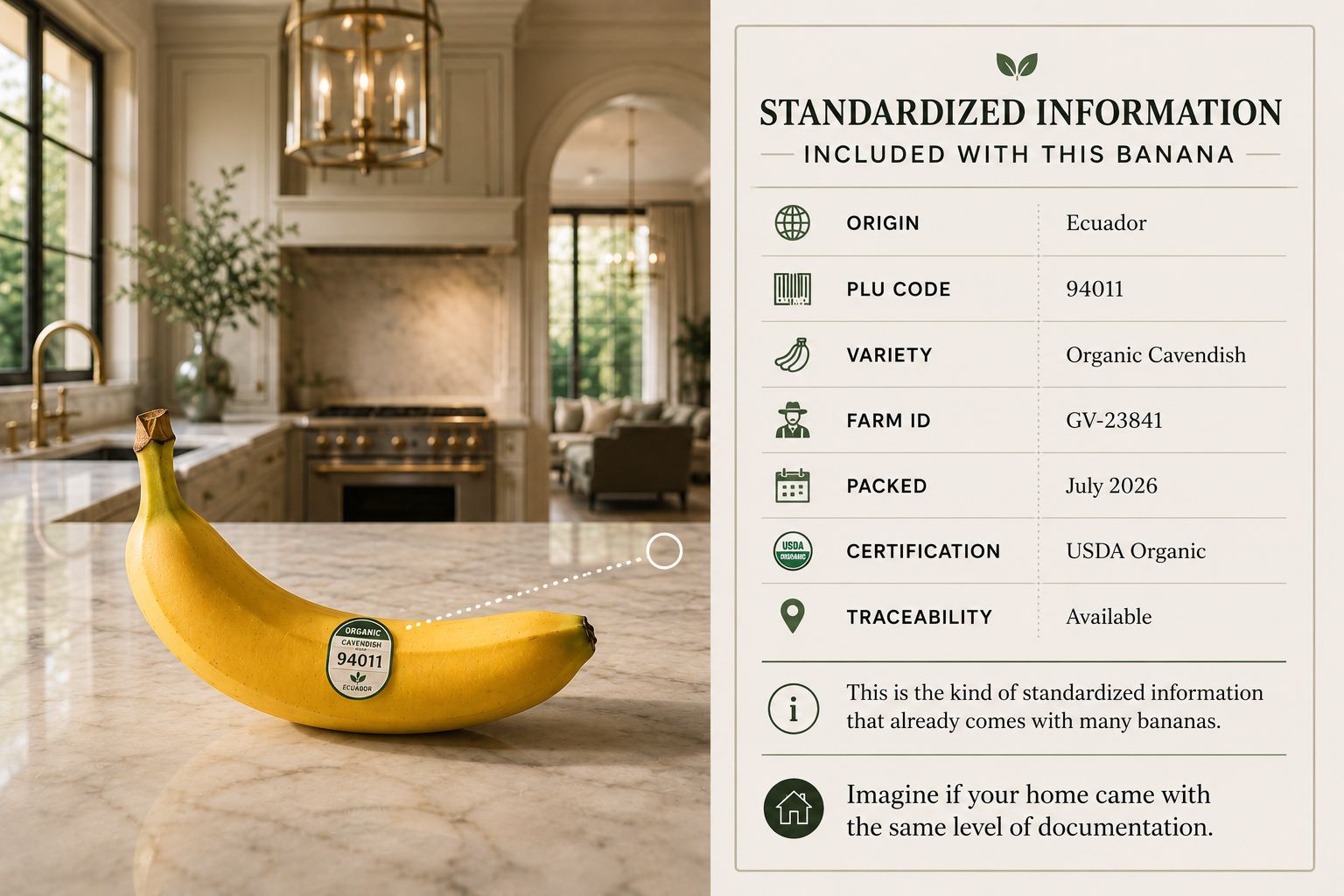
How can it be that a banana comes with more standardized information than your home, likely the biggest investment you’ll ever make?
That question has stayed with me.
It’s not because nobody has tried to solve the problem.
Roofers remember the roof. HVAC companies remember the furnace. Insurance companies remember claims. Manufacturers remember warranties. Counties remember permits. Homeowners save receipts.
Every one of them is preserving something valuable.
Everyone remembers their own piece.
Nobody remembers the house.
That isn’t because anyone is doing something wrong. Every company is solving the problem it was built to solve.
The problem is that a house doesn’t experience life one contractor at a time.
It experiences everything.
The roof affects the attic. The attic affects the insulation. The insulation affects the HVAC system. The plumbing affects the kitchen renovation. The tree planted today changes the yard twenty years from now.
To the house, those aren’t separate events.
They’re one continuous story.
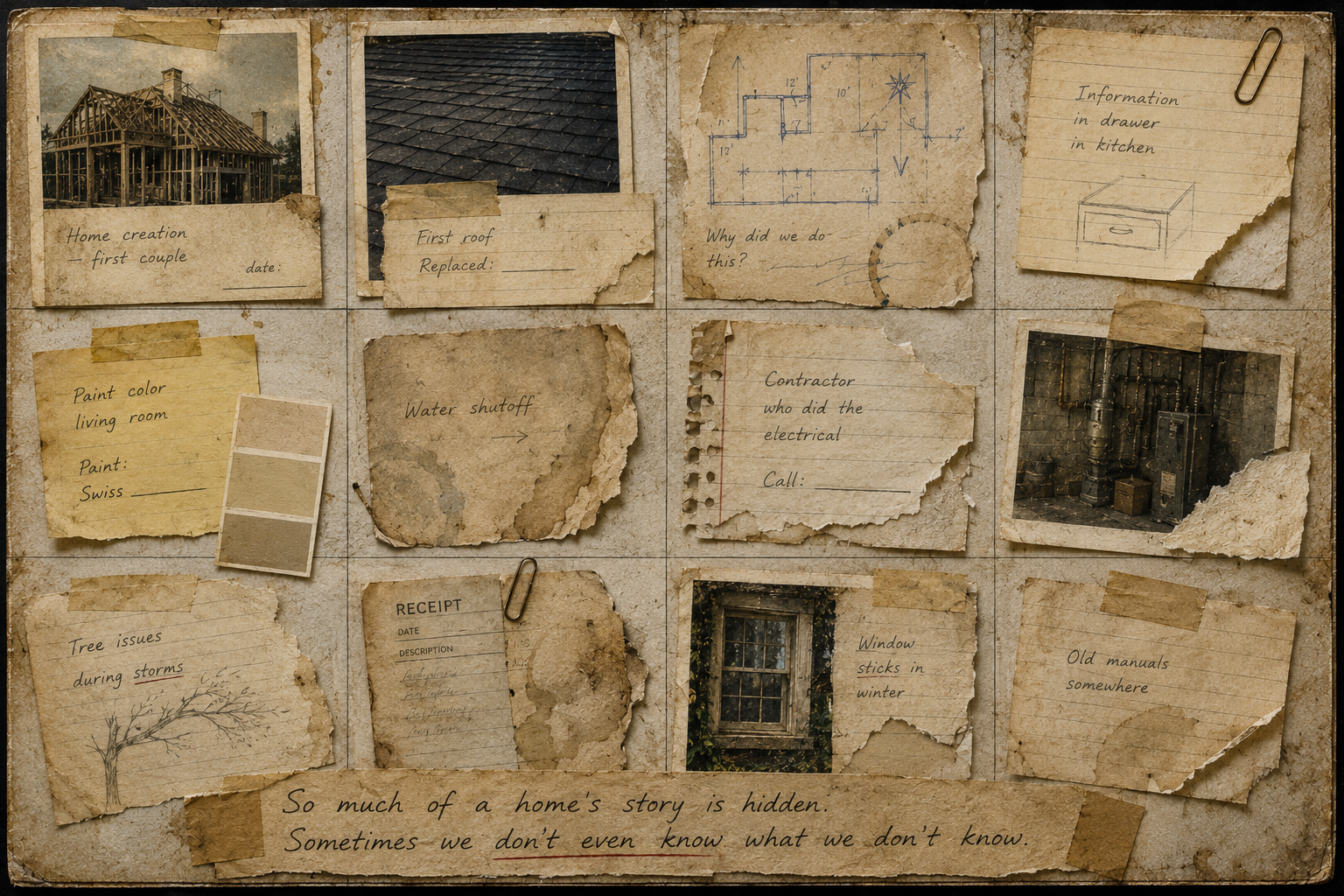
To us, they’re scattered across emails, filing cabinets, contractor portals, county websites, warranty cards, old phones, and fading memories.
Nobody expects a homeowner to leave behind everything they learned and piles of faded papers covered in handwritten notes.
But even if they did, where would you begin?
Who has the time to sort through decades of receipts, manuals, warranties, inspection reports, invoices, photographs, and sticky notes just to piece together the story of the house they just moved into so they can understand it?
That’s practically a full-time job.
Somewhere along the way, we stopped thinking about the house itself.
It became the place where we installed the next appliance, the next gadget, the next smart device, and the next upgrade.
We got excited about what we were adding.
Meanwhile, the house quietly kept collecting stories, repairs, lessons, and history.
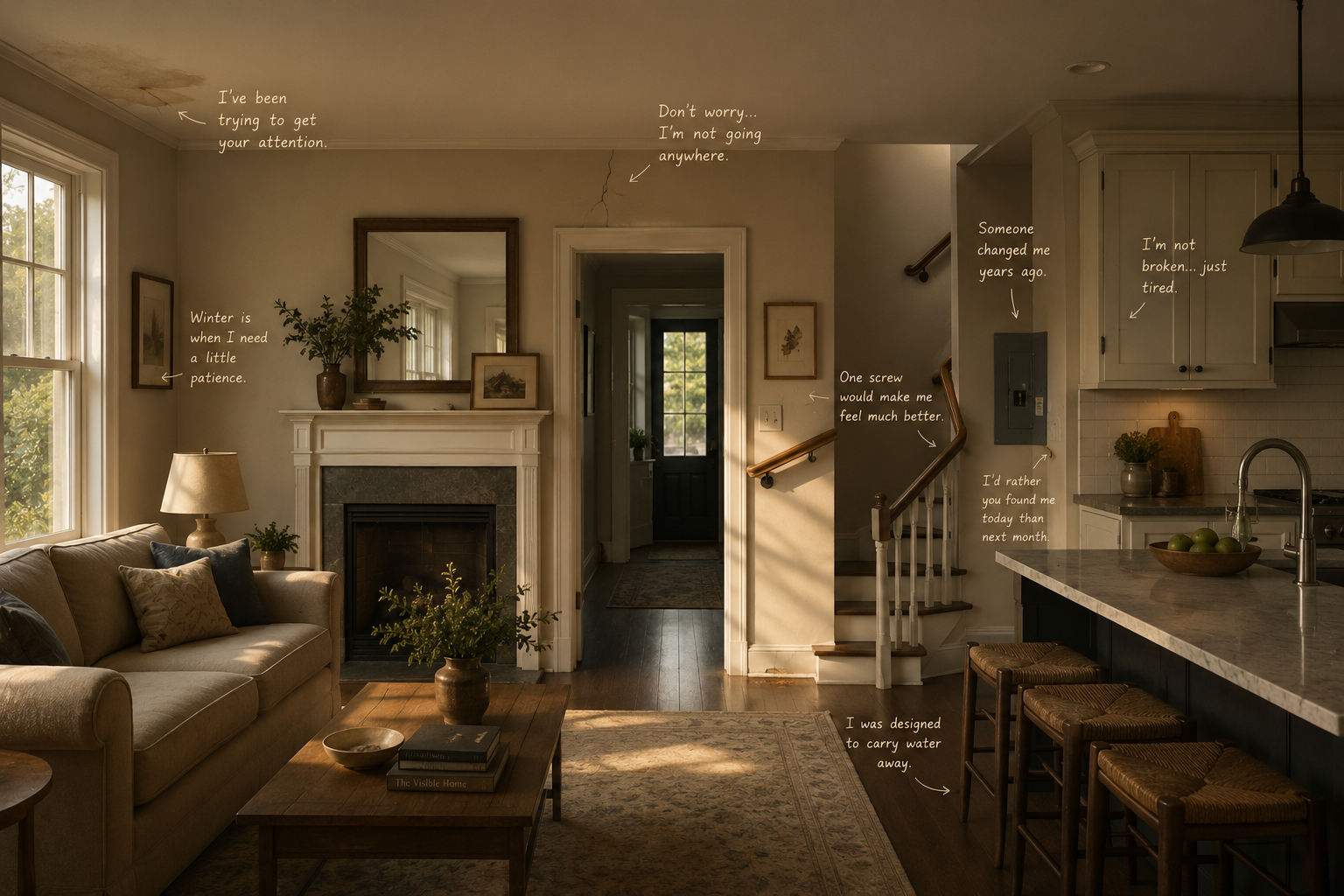
It was telling us what it needed.
We became remarkably good at ignoring it until the house finally screamed,
“Something’s broken.”
The world didn’t get worse.
It got more complex.
When I was eighteen, I could usually lift the hood of a car and figure out what was wrong. Today I open the hood of a modern car and half of what I see looks like it belongs in a server room.
Homes followed the same path.
Every year they became more capable.
More connected.
More sophisticated.
That’s exactly why preserving knowledge became more important, not less.
We upgraded the technology.
We never figured out how to preserve the knowledge needed to understand it, maintain it, and eventually pass it on to the next homeowner.
Every homeowner eventually turns an unfamiliar house into a familiar one.
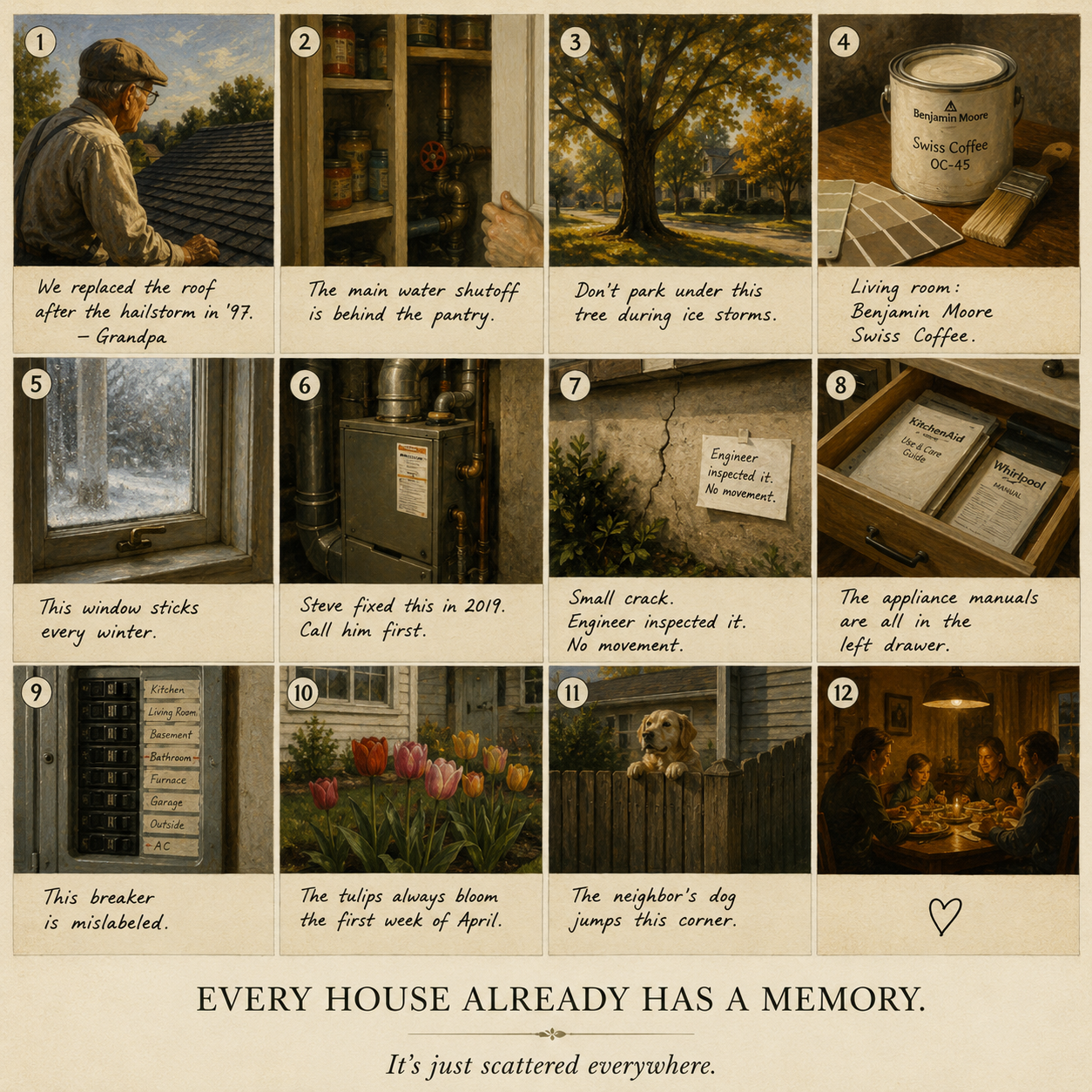
They learn where the hidden shutoff valve is. Which contractor actually stands behind their work. Why one window sticks every winter. Which tree always drops branches during the first heavy storm.
Then they move.
Most of what they learned disappears with them.
The next family starts over.
It doesn’t have to be that way.
We’re living through a moment when technology is advancing faster than ever before. Artificial intelligence is changing how we work. Our homes are becoming more connected every year. Information has never been easier to create.
And yet the knowledge that matters most still disappears every time a family moves.
At some point, someone has to stand up and say,
This matters.
Not because it’s profitable.
Not because it’s fashionable.
But because the people who come after us shouldn’t have to spend years rediscovering lessons someone else already paid to learn.

Maybe the question isn’t why homes haven’t had a memory.
Maybe the real question is why we’ve accepted that they shouldn’t.
This essay belongs to Potomac Lux's continuing Journal sequence on the day homes started remembering, the missing file every homeowner needs, why homes deserve the same continuity we expect from cars, the limitations of a brief inspection without a home's history, and the ancient human problem of preserving knowledge.
After reading this article,
ask yourself one question:
If something important happened in your home tomorrow, would you know exactly where to find the history?
Start building your home’s memory today.
START YOUR HOME RECORD →Free to use. Paid projects and hands-on services are priced separately.
Continue Exploring
Related reading for the same homeownership context.
Home Memory
The Day Homes Started Remembering
A cornerstone essay on home memory, home history, and the quiet transformation that begins when a home's records, decisions, and lessons remain connected over time.
Home Memory
What If Your Best Referral Came From the House Itself?
A Potomac Lux Journal essay on contractor legacy, home memory, and how exceptional work can keep earning trust long after a project is complete.
Home Memory
You’re About to Buy a Million-Dollar Home. I Hope Your Inspector Finds Every Issue in Two Hours or Less.
A home may hold decades of repairs, recurring problems, and hidden history. Yet buyers often receive only a brief visual inspection before making a million-dollar decision.
Home Memory
Your Home Should Remember. Nothing Personal.
A home’s useful history should survive a move without exposing the private life of the family who lived there. Here is the standard Potomac Lux believes every home-information system should follow.