
Calm homeownership
Sometimes a House Is Just Being a House
Before you spend $10,000 fixing your house, find out if it can wait.

Not every crack, leak, strange noise, or aging piece of equipment means something terrible is about to happen. Sometimes it does, and somebody should be willing to tell you that clearly. But sometimes a house is just being a house. That distinction sounds simple, but once we started building Potomac Lux, it became one of the things we thought about most carefully.
If you are creating a system that is supposed to help someone take care of a home, eventually you run into a basic question: what are we actually trying to get the homeowner to do? For us, the answer is not “buy something.” It is to make the right decision. Sometimes the right decision is to repair something now. Sometimes it is to plan for it. And sometimes the right decision is to do absolutely nothing.
A crack does not always mean catastrophe
I have a crack in my own basement. It sits underneath our kitchen sink, which is about the worst possible place to discover one if you have an active imagination. When I first noticed it, my mind immediately went where most homeowners’ minds probably go: there is a leak, something is moving, something expensive is happening behind this wall.
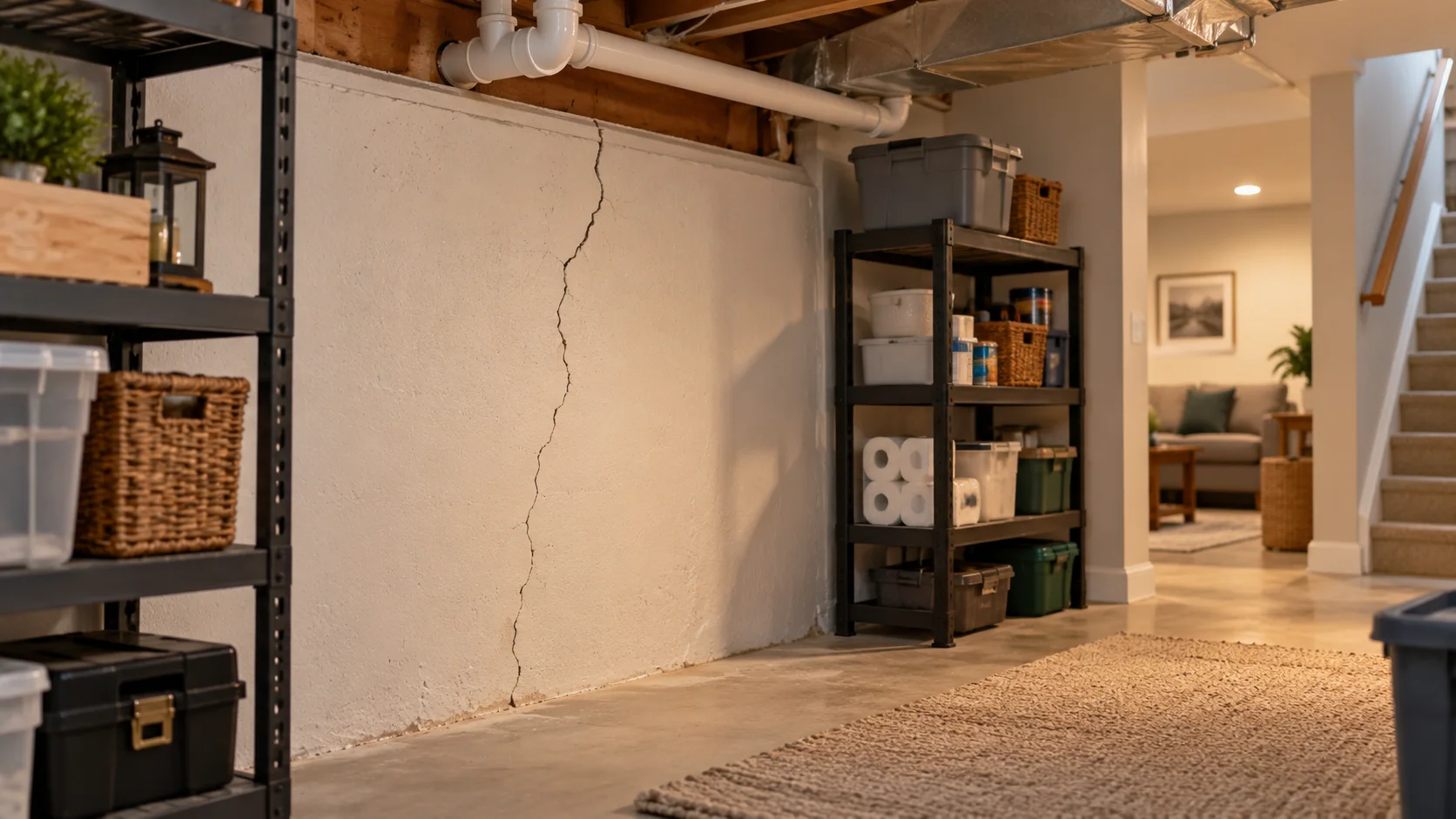
That was about two years ago, and the crack has not noticeably changed. Maybe the house settled. Maybe the material moved over time. Houses do that. I sometimes think of it like the crack that forms across the top of a cake when it comes out of the oven. The cake settles, the crack forms, and then that is more or less where it stays. I am not suggesting anyone diagnose a structural problem using dessert, but the point is that context matters.
A new crack that is rapidly expanding is very different from a small crack that has remained unchanged for years. A water stain that is actively wet is different from evidence of an old leak that was already repaired. An aging roof is different from a failing roof. The problem is that when you own a home, all of those things can feel equally alarming when you first discover them. That is when good judgment becomes valuable.
If you build a hammer, everything starts to look like a nail
I have worked around home-service companies for years, and there are a lot of very good people in this industry. But there are also businesses whose real machinery is sales. They generate the lead, identify the problem, make the sale, and then someone else may ultimately perform the work.
There is nothing wrong with selling a legitimate service that someone actually needs. But incentives matter. If your entire business is designed around creating the next transaction, it becomes very difficult for that business to look at a homeowner and say, “Do not spend the money.”
That is one of the reasons we have deliberately kept Potomac Lux focused. We are not trying to manufacture as many transactions as possible. We are trying to take care of the home. Those are not always the same objective.
If something should be repaired now, we should tell you. If spending $2,000 today is likely to prevent a much larger expense later, we should tell you that too. But if something is perfectly reasonable to watch for another year, we need to be just as comfortable saying, “Leave it alone. We will keep an eye on it.”
The relationship matters more than the transaction
We want our incentives to align with the homeowner’s. That means accepting that sometimes doing a good job for someone results in no immediate sale at all.
Maybe you are having a difficult year financially. Maybe there are three things your house could use, but only one of them truly needs attention. Maybe you finally have a little extra money and this actually is the smart year to replace something before it becomes an emergency. The right advice should change with the circumstances. The truth should not.
That is the relationship we want Potomac Lux to have with homeowners. Not someone constantly knocking on the door with another thing to sell, but someone knowledgeable in your corner who understands the house, remembers what has happened to it, knows what is coming, and is willing to give you the same advice they would want someone to give their own family.
Sometimes that advice will be uncomfortable. Sometimes it will be a relief. Both are part of taking care of a home properly.
We spent a surprising amount of time thinking about how a machine should talk to someone
Potomac Lux is software. Underneath everything, there is code. But people do not experience code. They experience what it tells them.
And when software is talking about the place where you sleep, raise your family, keep your belongings, and invest a huge portion of your wealth, the way it communicates matters. We do not want homeowners opening Potomac Lux and being greeted by an endless dashboard of warnings. We do not want every aging component painted red. We do not want normal homeownership converted into a permanent state of emergency.
We wanted something closer to the person everyone wishes they had in their family: the warm uncle who happens to know an unreasonable amount about houses. The person who looks at something and says, “Yes, we are going to have to deal with that,” and then, when appropriate, adds, “But not today.”
That distinction has influenced the way we think about priorities, recommendations, timing, costs, uncertainty, and even the language the system uses. There is a big difference between identifying a problem and helping somebody live well with a house. We are interested in the second one.
No mystery about the money
There is another piece of trust that matters just as much to us: transparency.
Homeowners should not have to decode how the person advising them is getting paid. We try to make what Potomac Lux costs and what we charge clear ahead of time, and we put as much as possible out in the open. If we are recommending something, you should understand why. If there is a cost associated with it, you should understand that too. And if our recommendation is to keep your money in your pocket, that should be just as easy for us to say.
The best long-term relationship is one where neither side is constantly trying to figure out what the other side’s angle is. We would rather earn trust slowly than manufacture urgency quickly.
What we are actually trying to build

There are a few moments I think about when imagining someone using Potomac Lux. After five minutes, I want them to think, “How does this know so much about my house? I did not even know that.” After ten minutes, I want them to see enough value that they want to finish adding the rest of their home.
A couple of months later, I want something different: peace of mind. And after the first time something really goes wrong, I want the homeowner to have a very simple reaction: “My home is in good hands.”
By then, the history is there. The information is there. The priorities are there. We know what has happened before, we can help figure out what should happen next, and when professional work is necessary, we can help coordinate the right vetted, licensed, insured professionals to take care of it.
You should not have to reconstruct your entire house every time something breaks. You should not have to wonder whom to call. And you should not have to assume that every imperfection is an emergency.
Sometimes we will tell you something needs attention. Sometimes we will tell you it is time to spend the money. And every once in a while, hopefully when you really need to hear it, we will tell you not to worry about that right now.
We will remember it. We will come back to it when the time is right. In the meantime, go enjoy your house.
Sometimes a house is just being a house.