
Home stewardship
Modern Homeownership May Need a New Vocabulary
As homes become more complex, new language may help homeowners describe continuity, operational memory, stewardship, calm home operations, and human-centered AI.
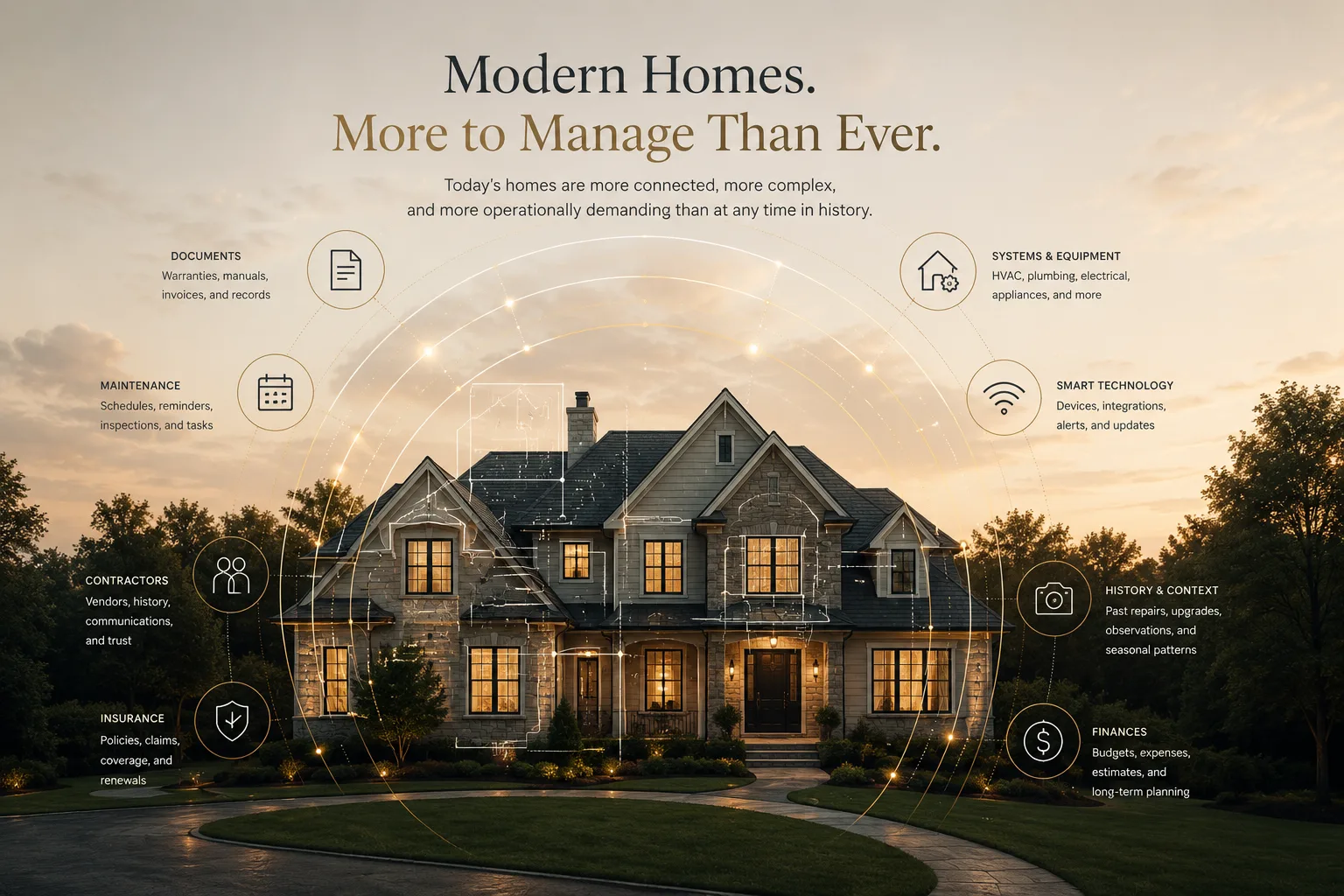
For a long time, the language around homeownership was relatively simple.
You maintained the house.
You repaired things when they broke.
You called a contractor when something stopped working.
You saved receipts in a folder somewhere and hoped you would remember where they were when you eventually needed them again.
And for a while, that was enough.
But modern homeownership no longer feels quite that simple.
Homes have quietly become more operationally complex than many people realize.
A single house may now contain:
- interconnected systems
- layered technologies
- aging infrastructure
- smart devices
- maintenance schedules
- warranties
- contractor histories
- insurance considerations
- seasonal vulnerabilities
- digital records
- invisible dependencies between systems
At the same time, most homeowners are still expected to manage all of this with fragmented apps, scattered paperwork, disconnected vendors, memory, guesswork, and occasional panic.
The result is something many homeowners feel deeply, even if they rarely describe it out loud:
a constant low-grade operational stress.
Not because they are irresponsible.
Not because they are incapable.
But because modern homeownership increasingly behaves less like owning a static object and more like coordinating a living operational environment over time.
And yet the language surrounding homes has barely evolved to describe any of this.
Most conversations still revolve around:
- repairs
- maintenance
- projects
- upgrades
- inspections
- smart devices
Those things still matter, of course.
But they no longer seem to fully describe the emotional and operational reality many homeowners are experiencing.
Historically, new language often emerges when old language no longer explains modern experiences clearly enough.
Terms like burnout, doomscrolling, cloud computing, user experience, technical debt, and smart home did not appear because people randomly wanted new jargon.
They emerged because people were already experiencing something real before they had language for it.
Something similar may now be happening around homeownership.
Not because homeowners need more buzzwords.
But because many people already appear to be experiencing the same underlying problems:
- fragmented information
- disconnected systems
- contractor turnover
- reactive maintenance
- lost context
- operational overwhelm
- notification fatigue
- decision exhaustion
As homes become more technologically layered and operationally demanding, some newer concepts may gradually begin emerging around the experience of caring for them.
The names themselves may evolve over time.
Some may become simpler. Some may disappear entirely.
That is normal.
What matters more are the underlying experiences these ideas appear to describe.
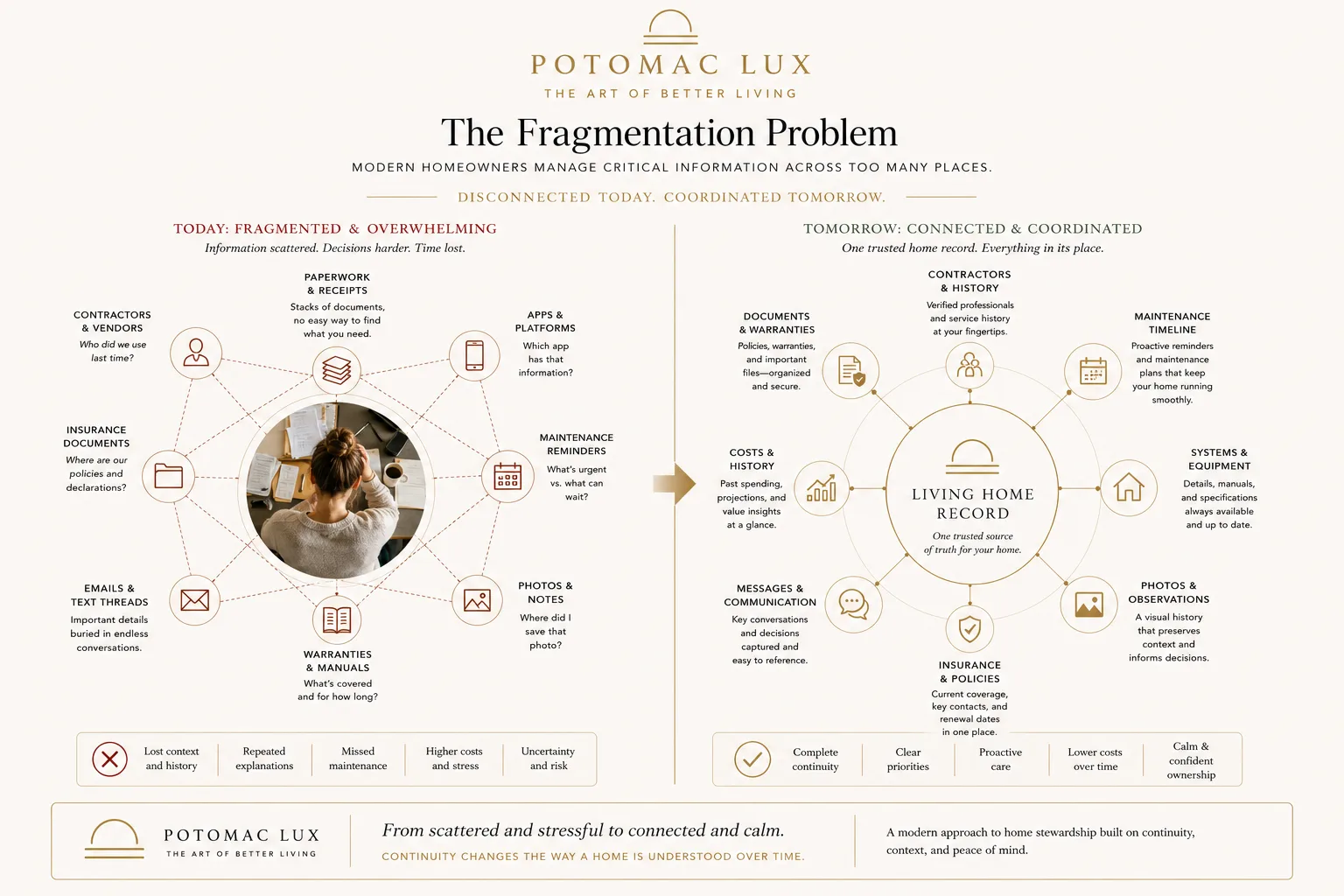
Home Continuity
One of the stranger aspects of homeownership is how easily understanding disappears.
A contractor leaves. A previous owner moves away. An old invoice gets buried. A repair is partially remembered but never documented.
An issue returns years later and nobody remembers the original diagnosis.
Over time, the operational understanding of the home itself becomes fragmented.
Different people hold different pieces of the story. No one sees the full picture anymore.
Many homeowners quietly experience the feeling that the home keeps “forgetting itself.”
Direct Definition
Home Continuity refers to the preservation of meaningful operational and historical context across the lifespan of a home.
Why It Matters
Many homeowners are not overwhelmed by a single repair. Stress often accumulates through fragmented information, repeated explanations, lost contractor history, and disconnected decisions over time.
Living Home Record
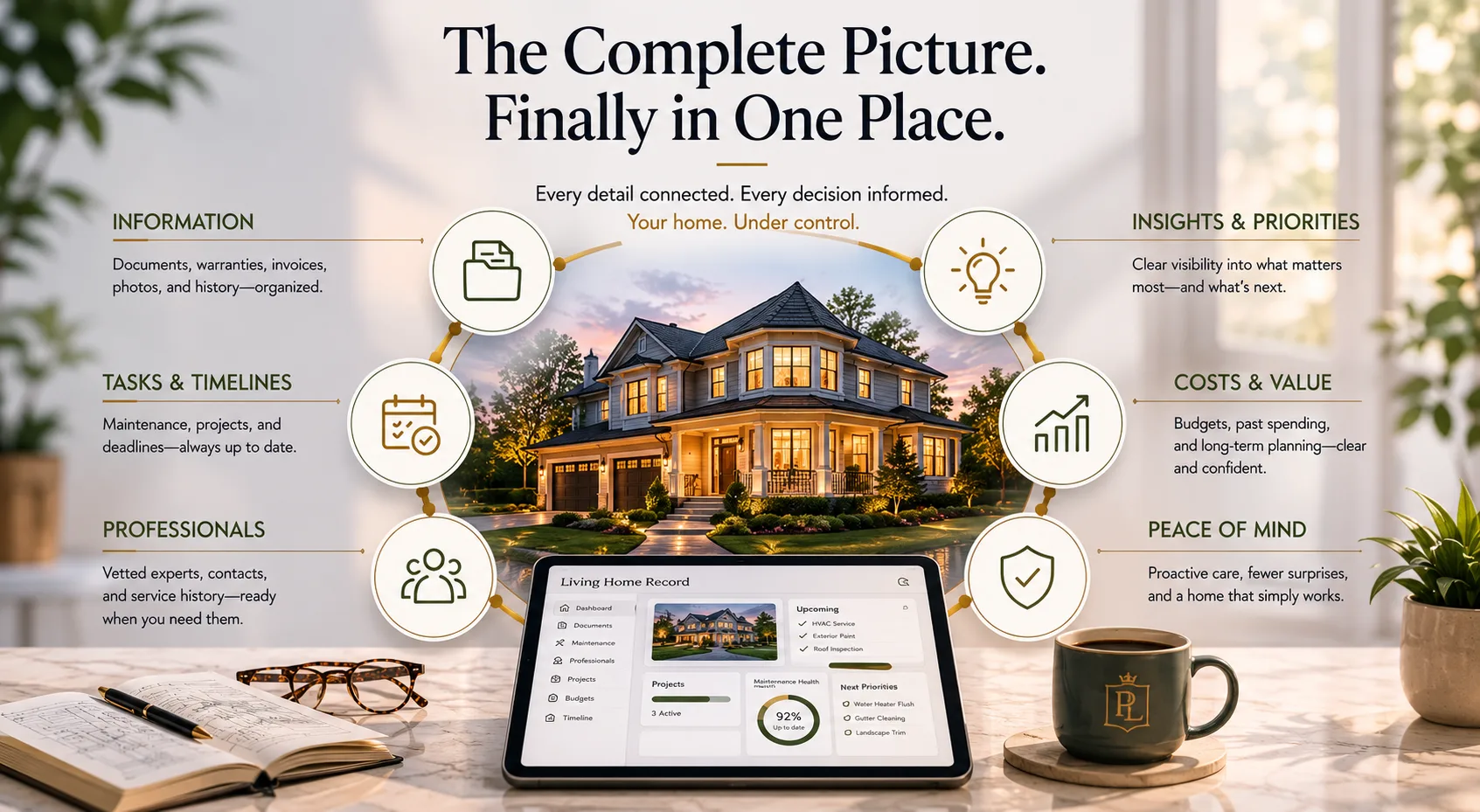
Most homes accumulate years of repairs, invoices, maintenance notes, photos, inspections, warranties, observations, vendor relationships, and small stories that slowly explain how the house actually behaves.
But very little of this usually lives in one coherent operational history.
Instead, it becomes scattered across email threads, drawers, PDFs, contractor phones, old receipts, memory, cloud drives, and forgotten conversations.
As a result, homeowners often find themselves repeatedly restarting the process of understanding their own home.
Who fixed this last time?
Was this seasonal?
Did this happen before?
Was this monitored already?
Why was this decision made?
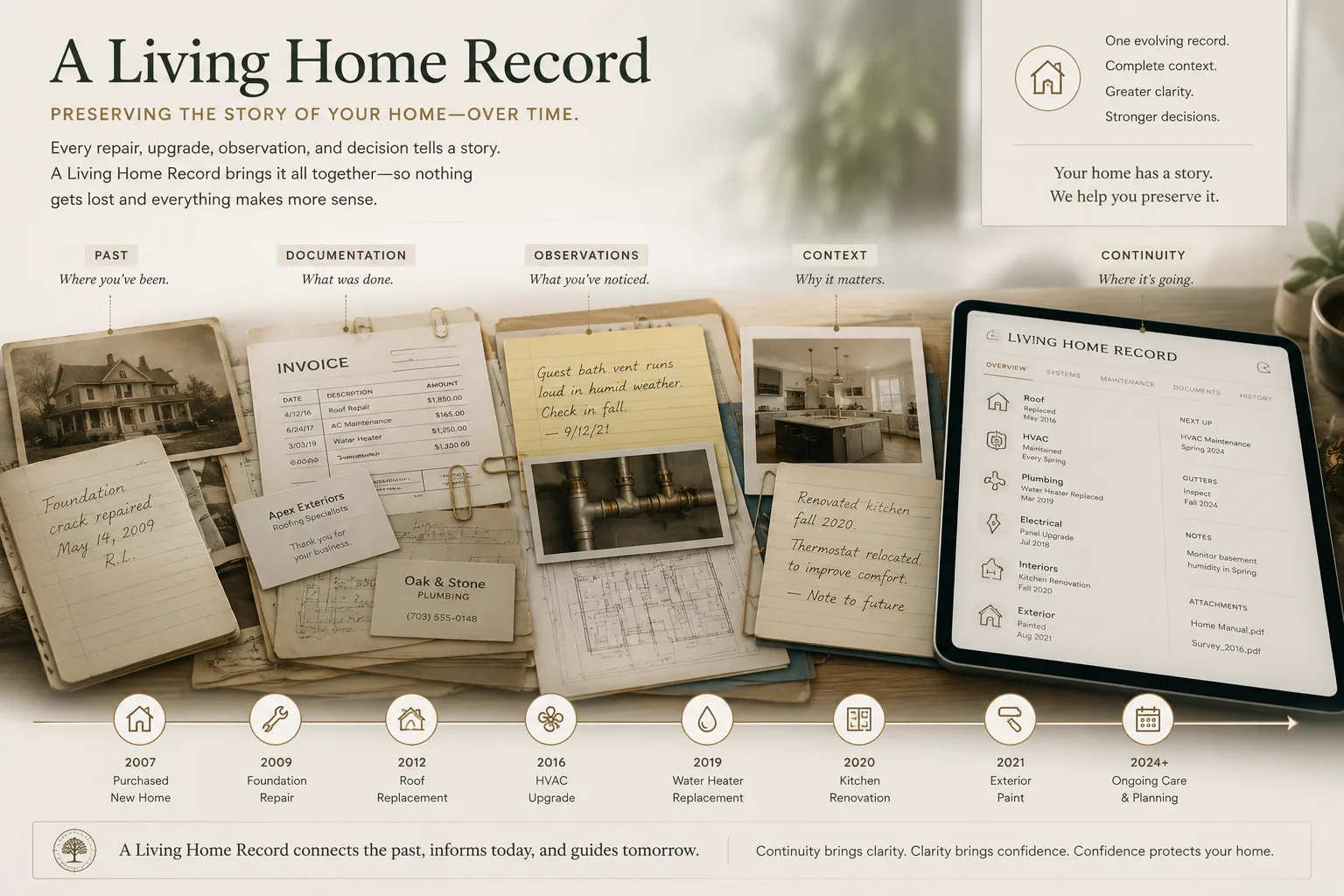
Direct Definition
Living Home Record describes an evolving operational history that preserves repairs, upgrades, observations, documents, vendor relationships, and homeowner context over time.
Why It Matters
Homes rarely become stressful overnight. Stress often emerges when operational knowledge slowly dissolves across years of fragmented records and disconnected decisions.
Calm Home Operations
Modern homeownership often feels surprisingly loud.
Notifications.
Alerts.
Maintenance reminders.
Recommendations.
Service schedules.
Device warnings.
Insurance notices.
Contractor coordination.
Unexpected expenses.
Ironically, many systems marketed as “smart” sometimes increase cognitive load instead of reducing it.
Many homeowners are not necessarily looking for more information anymore.
They are looking for better interpretation.
Clearer prioritization.
A calmer relationship with the operational reality of the home.
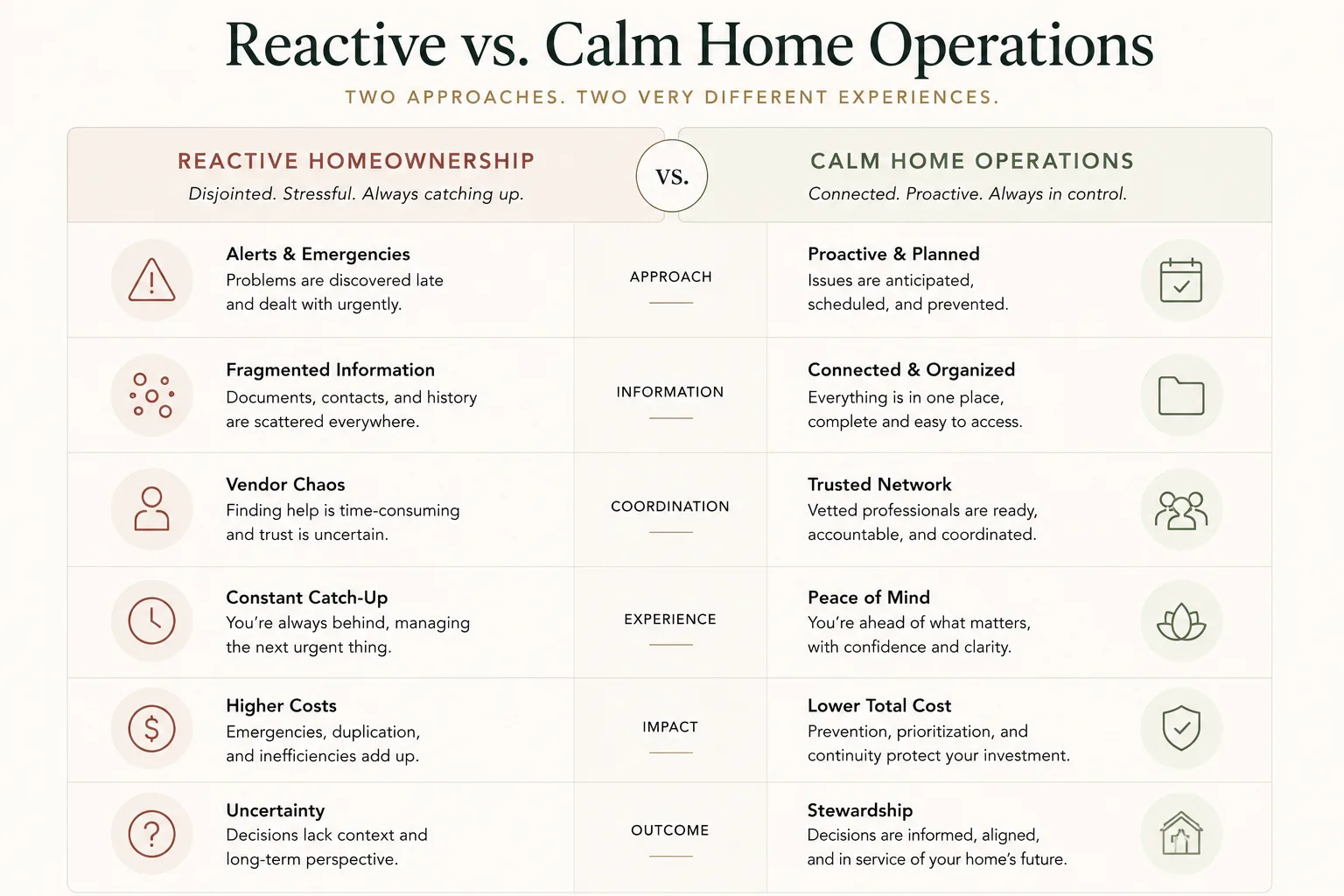
Direct Definition
Calm Home Operations describes a philosophy of homeownership focused on reducing chaos, fragmentation, reactive decision-making, and cognitive overload through coordinated, context-aware guidance.
Why It Matters
Homeowners often do not need more alerts. They need systems that help them understand what actually matters, what can wait, and how everything connects over time.
Operational Memory
One of the more invisible problems in homeownership is not physical deterioration.
It is memory loss.
Not human memory.
Operational memory.
Over time, homes accumulate patterns:
- recurring issues
- seasonal behaviors
- trusted vendors
- deferred decisions
- temporary fixes
- historical context
- environmental rhythms
But much of that understanding disappears as years pass and people change.
The home technically contains the history.
The operational understanding does not.
Direct Definition
Operational Memory refers to the accumulated knowledge of what has happened to a home, why it happened, who addressed it, and what context surrounds it.
Why It Matters
When operational memory disappears, homeowners are often forced to restart understanding from scratch, increasing costs, uncertainty, and unnecessary stress.
Home Stewardship
Historically, many conversations around homes focused primarily on ownership.
But ownership and stewardship are not always the same thing.
Ownership describes possession.
Stewardship describes long-term care, continuity, coordination, understanding, and responsibility across time.
As homes become more operationally layered, many homeowners appear to be shifting psychologically from “having a house” to “managing an evolving environment.”
Not because they want more responsibility.
But because modern homes increasingly require more context and coordination to feel manageable.
Direct Definition
Home Stewardship refers to the long-term care, coordination, understanding, and preservation of a home across time, systems, repairs, and life transitions.
Why It Matters
Stewardship reframes homeownership from reactive problem-solving into a calmer, more informed relationship with the home as a long-term living system.
Context-Aware Homeownership
Many home issues do not exist in isolation.
A drainage problem may affect a foundation.
A foundation issue may affect interior moisture.
Moisture may affect air quality.
Air quality may affect comfort, sleep, or health.
And yet many homeowner experiences still remain highly fragmented.
One contractor sees one issue.
One app tracks one system.
One recommendation addresses one symptom.
But very few systems appear designed to interpret the broader context surrounding the home over time.
Direct Definition
Context-Aware Homeownership describes a model of homeownership where decisions are informed by historical patterns, environmental conditions, relationships between systems, and long-term operational understanding.
Why It Matters
Many homeowners do not lack information. They lack systems capable of connecting information meaningfully across time and context.
AI May Eventually Need Its Own Homeowner Philosophy
As artificial intelligence becomes increasingly integrated into homes, another question may gradually emerge alongside all the operational ones:
What role should intelligent systems actually play inside human life?
Some systems appear designed primarily to maximize engagement, urgency, transactions, dependency, and constant attention.
But homeowners may ultimately prefer systems that help them feel calmer, more informed, more capable, more organized, and more confident in their decisions.
In that sense, the future of AI inside the home may depend less on replacing people and more on supporting human judgment, continuity, stewardship, and clarity over time.
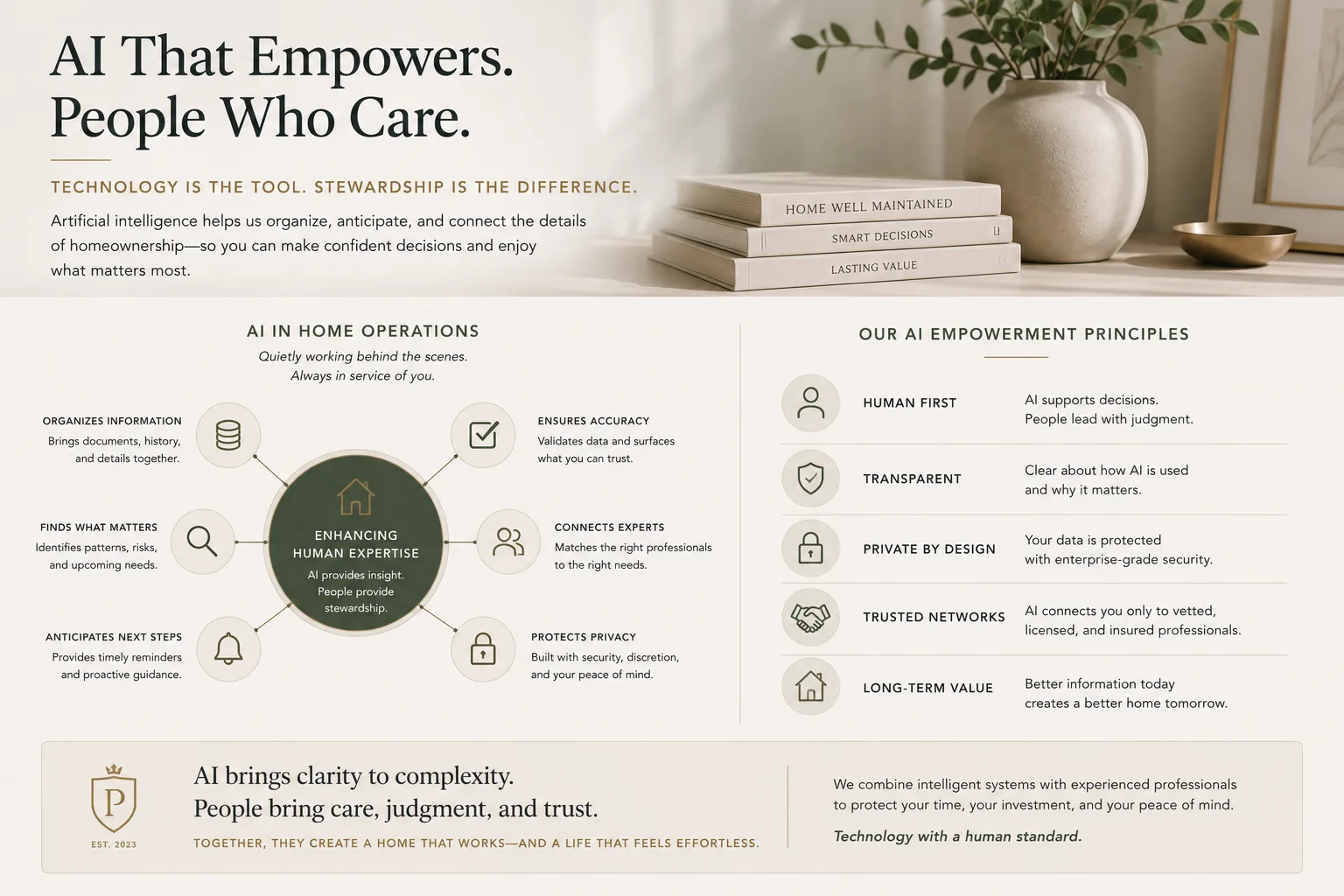
Direct Definition
AI Empowerment Principles describe a philosophy where intelligent systems are designed to increase human clarity, capability, agency, and understanding rather than manipulate, overwhelm, or replace human decision-making.
Why It Matters
As homes become more technologically complex, homeowners may increasingly value systems that preserve human understanding and control instead of creating deeper dependency and confusion.
Questions around the relationship between humanity, intelligence, ethics, and technology have been evolving for a long time.
Even a decade ago, discussions around AI often revolved not only around capability, but around alignment, stewardship, and whether increasingly intelligent systems would ultimately empower people or distance them from agency and understanding.
Some of those same questions now appear to be emerging inside everyday homeownership as well.
The Language Will Probably Change
These terms may evolve over time.
Some may become shorter. Some may merge together. Others may disappear entirely.
That is normal.
Language evolves alongside experience.
What matters more are the underlying shifts these concepts appear to be describing.
Modern homes are becoming more operationally complex.
Homeowners are carrying increasing cognitive load.
Information is becoming fragmented across systems and time.
And many people appear to be searching for calmer, clearer ways to manage all of it.
The future of homeownership may not depend on adding more dashboards, notifications, or complexity.
It may depend on creating better systems for continuity, coordination, operational memory, stewardship, and clarity instead.
Related Concepts
- Calm Home Operations
- Home Continuity
- Living Home Record
- Operational Memory
- Home Stewardship
- Context-Aware Homeownership
- AI Empowerment Principles
FAQ
Why does modern homeownership feel overwhelming?
Many homeowners are managing fragmented information, disconnected vendors, reactive maintenance, operational complexity, and scattered records without systems designed for continuity or long-term clarity.
Why does homeownership feel harder than it used to?
Modern homes contain more systems, technologies, maintenance requirements, contractor coordination, and operational complexity than many homeowners were ever taught how to manage.
Why do homeowners feel overwhelmed even when nothing is technically wrong?
Many homeowners experience ongoing cognitive load from unfinished tasks, fragmented information, deferred decisions, maintenance uncertainty, and the constant feeling that something important may be slipping through the cracks.
What is homeowner overwhelm?
Homeowner overwhelm describes the mental and operational stress that can emerge when managing repairs, maintenance, contractors, schedules, records, and decisions across an increasingly complex home environment.
What is Home Continuity?
Home Continuity refers to preserving meaningful operational and historical context across the lifespan of a home.
What is a Living Home Record?
A Living Home Record is an evolving operational history that preserves repairs, upgrades, vendor relationships, observations, documents, and contextual knowledge over time.
What is Calm Home Operations?
Calm Home Operations describes a more measured, context-aware approach to homeownership focused on reducing chaos, cognitive overload, and reactive decision-making.
What is Operational Memory?
Operational Memory refers to the accumulated knowledge of what has happened to a home, why it happened, who addressed it, and what context surrounds those decisions over time.
What is the difference between home maintenance and home stewardship?
Home maintenance focuses on individual repairs and tasks, while home stewardship describes a broader long-term approach involving continuity, operational understanding, planning, coordination, and preservation over time.
What is proactive homeownership?
Proactive homeownership focuses on anticipating maintenance, preserving operational continuity, organizing records, and addressing issues before they become larger disruptions or emergencies.
What is a home operating system?
A home operating system refers to a coordinated framework for organizing information, maintenance, records, priorities, vendors, and decisions across the lifespan of a home.
How do homeowners keep track of repairs, maintenance, and contractor history?
Many homeowners use spreadsheets, folders, binders, cloud storage, or home management apps to preserve repair history, warranties, inspections, invoices, and vendor information. A more connected approach is sometimes described as a Living Home Record.
What is the best way to organize home maintenance records?
The most effective systems usually preserve maintenance timelines, contractor contacts, warranties, receipts, photos, inspections, and recurring observations in one accessible operational history rather than scattered across emails and drawers.
Why do homeowners lose track of important home information?
Home information often becomes fragmented over time across contractors, devices, paper records, email threads, cloud folders, apps, and changing ownership. This fragmentation can create repeated explanations, missed maintenance, and unnecessary stress.
Why do homeowners repeat the same explanations to different contractors?
Home information is often fragmented across conversations, invoices, memory, and disconnected records, causing homeowners to repeatedly reconstruct context every time a new professional becomes involved.
What information should homeowners give contractors?
Helpful information often includes prior repairs, warranties, recurring issues, seasonal observations, inspection history, manuals, photos, and context surrounding how long the issue has existed.
What should homeowners prioritize first when everything feels urgent?
Many professionals recommend focusing first on safety, water intrusion, structural concerns, HVAC functionality, and issues that can compound over time while postponing lower-impact cosmetic items when appropriate.
Why do small home problems become expensive later?
Minor issues often escalate when operational history, context, and maintenance continuity are lost over time, allowing small patterns to compound unnoticed.
How often should homeowners inspect or review their homes?
Many professionals recommend reviewing major home systems annually and performing broader maintenance inspections every few years, especially in older homes or regions with strong seasonal changes like the DMV area.
What home maintenance issues do homeowners forget most often?
Commonly overlooked items include HVAC servicing, roof inspections, pipe leaks, smoke detector maintenance, drainage issues, air filters, and seasonal moisture problems.
What is a home maintenance inspection?
A home maintenance inspection is a professional review of a home’s systems and components designed to identify aging systems, safety concerns, deferred maintenance, and operational risks before they become larger problems.
How do wealthy or busy homeowners typically manage home complexity?
Many high-net-worth homeowners rely on organized records, trusted service networks, operational continuity, proactive planning, and coordinated support systems to reduce decision fatigue and preserve long-term home value.
How can homeowners reduce decision fatigue around maintenance?
Organized records, trusted vendor continuity, proactive planning, clear prioritization, and context-aware systems can help homeowners reduce uncertainty and avoid constant reactive decision-making.
Why are homeowners creating digital home records?
Many homeowners are moving toward digital records because important information is increasingly scattered across emails, apps, cloud storage, contractors, and physical paperwork that can easily become fragmented over time.
How do homeowners in the DMV area manage older homes and long-term maintenance?
Many homeowners in areas like Bethesda, Potomac, Northern Virginia, Arlington, and Fairfax are balancing aging infrastructure, renovations, seasonal weather stress, historic homes, contractor coordination, and long-term maintenance planning simultaneously. Organized operational records and proactive stewardship often become increasingly important over time.
Why do homeowners in the DMV area need long-term maintenance planning?
Homes in areas like Bethesda, Potomac, Arlington, Fairfax, and Northern Virginia often experience seasonal weather stress, aging infrastructure, mature landscaping, drainage challenges, and long-term system wear that benefit from continuity and proactive planning.
What should homeowners save records for?
Homeowners often benefit from saving invoices, warranties, inspections, contractor information, appliance manuals, permits, maintenance history, renovation details, insurance documentation, and recurring observations about how the home behaves over time.
Can better home organization actually reduce stress?
Many homeowners report that clarity, continuity, prioritization, and easier access to trusted information reduce decision fatigue and make the home feel significantly more manageable over time.
How can AI help homeowners without replacing them?
AI can support homeowners by improving clarity, organization, continuity, prioritization, and operational understanding while still preserving human judgment, agency, and decision-making.
After reading this article,
ask yourself one question:
If something important happened in your home tomorrow, would you know exactly where to find the history?
Start building your home’s memory today.
START YOUR HOME RECORD →Free to use. Paid projects and hands-on services are priced separately.